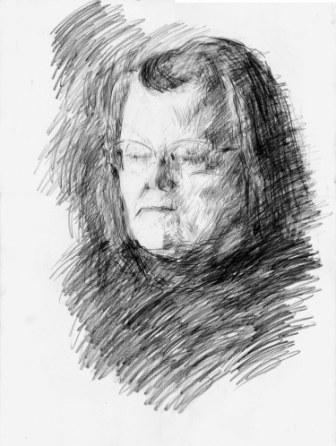
Is better than being denied thrice.
In reading the last few postings on your blog, I found I came up (uncredited) twice. When you had that actress perform a Wallace Shawn play in your home, I was in attendance. And yes, it was sleep-inducing. I believe you had also provided some snacks before hand. I think the cost was ten or more dollars. And, as regards "My Dinner With Andre", it was indeed a theatrical release (I've seen it three times and think it is great). Have you seen Shawn in "Vanya on 42nd Street"? I like it very much also.And, regards my second forgottenness, you told me at the time (perhaps it was hyperbole) that I was the inspiration to having your character writing all those lists. I indeed filled in my 'cash spent list' just yesterday, in a long line of yearly booklets which go back over a quarter century. For all I know you're forgetting me right now. Is that a 'wooiiee wooiiee'?
This is a reply from my good friend Dale to two of my recent blogs. He is the most disciplined writer I know, in the writing itself, in the editing, and in the sending the manuscripts out to agents and publishers.
Monday, February 26, 2007

Comment
My friend Ted, the owner of a Mac so that he can't post on my site, e-mails me this comment:
"Yes. Good nursing is in a transcendent realm of goodness."
"Yes. Good nursing is in a transcendent realm of goodness."
Sunday, February 25, 2007
On Being a Nurse
I have learned a lot about being a nurse the last 6 weeks. While Bill was in the hospital, I watched the nurses closely. I saw how they shaved him, and when he came home, I duplicated that. So far, knock on wood, I haven’t given him a knick. When the kids were little I played nurse on quite a few occasions. By coincidence, I have nursed 6 kids through chicken pox.
I have always admired nurses. They acquire an astonishing facility to do things most people couldn’t bring themselves to do: draw blood relatively painlessly, stick needles into tender body parts, and take care of various bodily wastes in a manner that doesn’t embarrass the patient. They also have a knack for getting the patient to do what he should be doing, eating or drinking the noxious substance or taking a pill, without sounding like a harridan.
When my dad was in the nursing home, not in his right mind, I heard a nurse say to him, laughing, “You like my poobahs, don’t you.” The nurse was from the Caribbean, and I realized that her poobahs were her breasts and that my father had touched them. She was not only kind to him, but pleasantly kind.
Over in One Word, Zhoen writes about being a nurse in the operating room. She seems to revel in her competence. To have that kind of competence in such an important job must be truly wonderful.
I have always admired nurses. They acquire an astonishing facility to do things most people couldn’t bring themselves to do: draw blood relatively painlessly, stick needles into tender body parts, and take care of various bodily wastes in a manner that doesn’t embarrass the patient. They also have a knack for getting the patient to do what he should be doing, eating or drinking the noxious substance or taking a pill, without sounding like a harridan.
When my dad was in the nursing home, not in his right mind, I heard a nurse say to him, laughing, “You like my poobahs, don’t you.” The nurse was from the Caribbean, and I realized that her poobahs were her breasts and that my father had touched them. She was not only kind to him, but pleasantly kind.
Over in One Word, Zhoen writes about being a nurse in the operating room. She seems to revel in her competence. To have that kind of competence in such an important job must be truly wonderful.
Saturday, February 24, 2007
My Weekly Column
I have been working on my "State of the Art" columns for the new arts section of the NB Telegraph Journal. When they first asked me to write for them, they wanted me to do a column every week, but I agreed to do one only every other week. I was afraid of a weekly deadline. Now the editor is again urging me to reconsider. I think I will give it a try. I have done a lot of art journalism -- profiles, reviews, news items -- but I have never had an opinion column, and I have always thought that it would be stimulating to have one. I am not a natural writer, that is, I don’t have an easy style or an instinctive humor, so I have to work at it. I envy Garrison Keillor, Rex Murphy, and David Brooks for their brilliant, original way of putting things. I loved the columns of the late Alden Nowlan. My memory has always been faulty and is getting faultier, and that is a detriment. However, the idea of the column has fired up my imagination, and I am often thinking, “That would make a good column.” Working on this blog has toned my muscles: one of the good things that has come of it.
Friday, February 23, 2007
synchronicity or maybe just coincidence
Yesterday I was looking for a book (which I didn’t find) and was amused that someone had put our two copies of Wallace Shawn’s The Fever on opposite ends of the bookshelf. A few hours later I was reading the latest copy of the NY Times Book Review, and saw that there was a review of the memoir of Wallace’s brother, Allen, illustrated with a photo of the brothers. I hadn’t thought of Wallace for quite a few years, and here he was, turning up twice.
In October of 1992, someone, I forget who, asked me if I would host the well-known actor Claire Coulter. This was something of an experiment, using people’s living rooms as a theatre. I was to invite people to come, and they were to pay, but I can remember only Ted and John although there were others. I can’t remember how much they had to pay. Coulter sat in our large maroon leather armchair and delivered a Wallace Shawn monologue in a normal tone of voice. Hosting the performance was a strange experience. over there were our usual friends, sitting in their accustomed places, and over here was a stranger, talking on and on. Ted told me later that he was afraid he would go to sleep and Bill agreed.
Did she perform The Fever? I don’t remember. I do have the two copies, one she gave us and one I bought for our daughter. I don’t know why I didn’t send it to her. Grace once got Bill to watch Shawn’s My Dinner with André with her. Was it on TV or did they go to the movies?
I thought it was a successful event, and I imagined other actors following her lead, but it never happened again. Our traveling actor friend Ellen Pierce would visit us occasionally, carrying with her all her worldly goods in various canvas bags. She was a master at making herself a cozy private nest within our house, pleasant to have around, not at all in the way. I would get her some gigs. One time she thought she would be paid on the spot, but red tape meant that she couldn’t be, so I had to lend her $30 to buy a bus ticket to her next engagement.
Both women weren’t just traveling mountebanks but were deeply committed to theatre and willing to make sacrifices to engage in it. I wish someone else would come along to enliven the scene.
In October of 1992, someone, I forget who, asked me if I would host the well-known actor Claire Coulter. This was something of an experiment, using people’s living rooms as a theatre. I was to invite people to come, and they were to pay, but I can remember only Ted and John although there were others. I can’t remember how much they had to pay. Coulter sat in our large maroon leather armchair and delivered a Wallace Shawn monologue in a normal tone of voice. Hosting the performance was a strange experience. over there were our usual friends, sitting in their accustomed places, and over here was a stranger, talking on and on. Ted told me later that he was afraid he would go to sleep and Bill agreed.
Did she perform The Fever? I don’t remember. I do have the two copies, one she gave us and one I bought for our daughter. I don’t know why I didn’t send it to her. Grace once got Bill to watch Shawn’s My Dinner with André with her. Was it on TV or did they go to the movies?
I thought it was a successful event, and I imagined other actors following her lead, but it never happened again. Our traveling actor friend Ellen Pierce would visit us occasionally, carrying with her all her worldly goods in various canvas bags. She was a master at making herself a cozy private nest within our house, pleasant to have around, not at all in the way. I would get her some gigs. One time she thought she would be paid on the spot, but red tape meant that she couldn’t be, so I had to lend her $30 to buy a bus ticket to her next engagement.
Both women weren’t just traveling mountebanks but were deeply committed to theatre and willing to make sacrifices to engage in it. I wish someone else would come along to enliven the scene.
Friday, February 16, 2007
Eerie
Last summer I wrote what I thought was a short story. It began with an image I had of a family event. In October, starting to type it up, I realized it wasn’t a short story but the beginning of a novel. This has happened to me on several occasions. I began to go deeper into the story, and several characters emerged, one of whom was the husband of the central consciousness, Anna. It also gradually emerged that her husband had had a severe stroke. My father had had several strokes, and I thought as I was writing that was the experience I was building on. My father’s strokes had left me with the dread that I would have one, leaving Bill to look after me.
Now the strange part: it wasn’t me who had the stroke but Bill.
In 1969 I was writing a novel (never published) about a woman who went on a protest walk to NYC. I wrote on a Thursday, and the next Tuesday I was called home because my mother had gone into a coma. A few days later she died. A few weeks later I went back to the novel and read what I had written on that Thursday: “When she was sixteen, her mother died.” I was troubled. Something similar has happened a number of times, although not quite so troubling. I wrote about a mother and father who were sitting in the “quiet room” of the emergency ward, where they put people whose loved one is in dire straits. Their son had had an accident. Once when I had been in the emergency ward with one of the kids for a minor reason, I had glimpsed the quiet room and saw a couple in it so I knew what it looked like. A few months after I wrote about the quiet room, Bill and I were sitting in the quiet room. Our son had been bitten in the face by a dog.
One of the main characters in my first published novel keeps more and more complicated lists. She makes lists of her different lists. Her daughter gives her nicely bound black books to keep the lists in, and they comprise a kind of family history. My mother kept lists but not as elaborate. A few years ago I realized I was keeping lists of lists, a book in which I listed where other lists were kept, like my character. And two years ago I bought a black book in which I write everything down so that I won’t forget and only later did I think of the black books of Flora’s mother.
It’s all kind of spooky.
Now the strange part: it wasn’t me who had the stroke but Bill.
In 1969 I was writing a novel (never published) about a woman who went on a protest walk to NYC. I wrote on a Thursday, and the next Tuesday I was called home because my mother had gone into a coma. A few days later she died. A few weeks later I went back to the novel and read what I had written on that Thursday: “When she was sixteen, her mother died.” I was troubled. Something similar has happened a number of times, although not quite so troubling. I wrote about a mother and father who were sitting in the “quiet room” of the emergency ward, where they put people whose loved one is in dire straits. Their son had had an accident. Once when I had been in the emergency ward with one of the kids for a minor reason, I had glimpsed the quiet room and saw a couple in it so I knew what it looked like. A few months after I wrote about the quiet room, Bill and I were sitting in the quiet room. Our son had been bitten in the face by a dog.
One of the main characters in my first published novel keeps more and more complicated lists. She makes lists of her different lists. Her daughter gives her nicely bound black books to keep the lists in, and they comprise a kind of family history. My mother kept lists but not as elaborate. A few years ago I realized I was keeping lists of lists, a book in which I listed where other lists were kept, like my character. And two years ago I bought a black book in which I write everything down so that I won’t forget and only later did I think of the black books of Flora’s mother.
It’s all kind of spooky.
Tuesday, February 13, 2007
The Milk of Human Kindness
What has ameliorated the awfulness of this past month is how kind, thoughtful, just plain nice people have been. The nurses in the Cardiac Care unit were so gentle and pleasant. I watched them shave Bill. They were careful, went slowly, rubbed shaving cream into the bristles gently. After he had his first cat scan, he smiled at the cardiac nurse who had accompanied him and she smiled at him, and he said to me and John, “With the help of my buddy here, I got through it.” It was as if together they had overcome a monumental obstacle.
My relatives and friends have rallied around. I have not a doubt that I could phone many different people, and they would be here immediately to help us. The ones far away have sent candy, Bill’s favorite fig squares, books, flowers, cards. They have phoned and e-mailed. The ones close by have visited, done errands, and brought food.
Yesterday we went to get Bill’s new glasses. I was filled with dread because his old ones have been unsatisfactory for several years – the bifocal part is so low that he can’t use them to read. The cheerful young woman put them on Bill and gave him something to read. I could tell that they weren’t right. She immediately said, “They’re not right. Who did those measurements anyway? You can’t use them. I’m sending them right back to the laboratory.” She called a colleague who agreed they weren’t right, and they discussed the proper positioning of the lower bifocals. Proper glasses might seem like a small thing compared to a stroke and possible lung cancer, but to someone whose life is reading and writing, it is huge.
Bill is, in many people’s opinion, both brilliant and eccentric. He sometimes is difficult to understand, but I can tell that everyone we have encountered in the last month has been trying hard to figure him out in a kindly way. A night nurse asked me what Bill did before he retired. I told her that he was a professor of English at UNB. Her eyes opened wide, she laughed, flung out her arms, and said, “That explains a lot! We wondered where all those big words were coming from.”
My relatives and friends have rallied around. I have not a doubt that I could phone many different people, and they would be here immediately to help us. The ones far away have sent candy, Bill’s favorite fig squares, books, flowers, cards. They have phoned and e-mailed. The ones close by have visited, done errands, and brought food.
Yesterday we went to get Bill’s new glasses. I was filled with dread because his old ones have been unsatisfactory for several years – the bifocal part is so low that he can’t use them to read. The cheerful young woman put them on Bill and gave him something to read. I could tell that they weren’t right. She immediately said, “They’re not right. Who did those measurements anyway? You can’t use them. I’m sending them right back to the laboratory.” She called a colleague who agreed they weren’t right, and they discussed the proper positioning of the lower bifocals. Proper glasses might seem like a small thing compared to a stroke and possible lung cancer, but to someone whose life is reading and writing, it is huge.
Bill is, in many people’s opinion, both brilliant and eccentric. He sometimes is difficult to understand, but I can tell that everyone we have encountered in the last month has been trying hard to figure him out in a kindly way. A night nurse asked me what Bill did before he retired. I told her that he was a professor of English at UNB. Her eyes opened wide, she laughed, flung out her arms, and said, “That explains a lot! We wondered where all those big words were coming from.”
Sunday, February 11, 2007
Vulnerable
Everyone knows that smoking is bad for you, but I didn’t realize just how bad it is. I knew that your chances of getting cancer rise when you smoke although not everyone who smokes gets cancer. If cancer were the only bad result, you would just be taking a gamble, like climbing Mt. Everest. Or even driving a car. I have learned, however, that there are many other results of smoking. The doctor told Bill that because of his smoking his condition is that of a man ten years older. There are so many things wrong with him that I am overwhelmed. For example, his ability to metabolize food is affected. And heart rhythm. And circulation. The only good thing that can be said of his smoking is that he was pretty old when his bad habit of 60 years caught up with him.
The young, pretty, female, heart resident leaned over Bill and asked him if he wanted his heart to be started again if it stopped. “This is something I have to ask you.” He might die, I thought. And then I thought, He is going to die. Now. Tonight.
Our youngest son was standing there too. I haven’t asked him what he thought. I only know that when our neighbor phoned him to tell him Bill had had a stroke, he left his house for the hour and a half drive without his wallet and in his crocs (in the middle of a New Brunswick winter.)
Now we are waiting. Bill can’t have anesthesia for at least another two weeks. We have had a month of harshly cold temperatures with bitter winds. We haven’t had such weather for several years. I can’t remember where I put our down-filled coats. He can’t have coffee or alcohol. And of course no cigarettes. He is having difficulty writing. The deadline for my column is tomorrow morning.
In her introduction of me in the new section of the newspaper, the editor called me “venerable.” A francophone woman e-mailed me about my first column and misquoted the word. She called me “vulnerable.”
The young, pretty, female, heart resident leaned over Bill and asked him if he wanted his heart to be started again if it stopped. “This is something I have to ask you.” He might die, I thought. And then I thought, He is going to die. Now. Tonight.
Our youngest son was standing there too. I haven’t asked him what he thought. I only know that when our neighbor phoned him to tell him Bill had had a stroke, he left his house for the hour and a half drive without his wallet and in his crocs (in the middle of a New Brunswick winter.)
Now we are waiting. Bill can’t have anesthesia for at least another two weeks. We have had a month of harshly cold temperatures with bitter winds. We haven’t had such weather for several years. I can’t remember where I put our down-filled coats. He can’t have coffee or alcohol. And of course no cigarettes. He is having difficulty writing. The deadline for my column is tomorrow morning.
In her introduction of me in the new section of the newspaper, the editor called me “venerable.” A francophone woman e-mailed me about my first column and misquoted the word. She called me “vulnerable.”
Wednesday, January 31, 2007
Chowder
My mother died young; her death was unexpected, unnecessary. We were distraught. The day after her death, nearly forty years ago, my cousin Gloria arrived at my father’s door with a fish chowder. It was beyond delicious; it was comforting, sustaining, life-affirming. When we brought Bill home from the hospital last week, a friend had a chicken soup waiting for us. It too was beyond delicious.
I have lost my appetite only once in my life, when I was in the hospital, very ill with pneumonia. I hadn’t appreciated what people meant when they told me they had lost their appetite. I thought it meant that they were full or that they didn’t particularly like what was put before them. When I lost any interest in eating, I was scared. I thought I might die, leaving Bill with three young ones to raise on his own. I have heard of people who at the end of their lives don’t eat or drink. That must mean that their will to live is gone.
Years ago a friend of mine gave me a Chinese recipe for chicken broth that was alleged to be particularly life-giving. It requires a fowl, not an easy thing to come by here, and fresh herbs, now easy to find but at that time impossible to buy in the winter. I must get out the recipe, find a fowl and make the broth.
Bill is on the mend for the time being although there are hurdles down the line. I have been blessed with the gift of living one day at a time. I hardly ever look more than a few months away, don’t “borrow trouble.” I weighed him this morning, and he has gained twelve pounds in one week. A lot of the weight must come from his drinking Boost three times a day.
I have lost my appetite only once in my life, when I was in the hospital, very ill with pneumonia. I hadn’t appreciated what people meant when they told me they had lost their appetite. I thought it meant that they were full or that they didn’t particularly like what was put before them. When I lost any interest in eating, I was scared. I thought I might die, leaving Bill with three young ones to raise on his own. I have heard of people who at the end of their lives don’t eat or drink. That must mean that their will to live is gone.
Years ago a friend of mine gave me a Chinese recipe for chicken broth that was alleged to be particularly life-giving. It requires a fowl, not an easy thing to come by here, and fresh herbs, now easy to find but at that time impossible to buy in the winter. I must get out the recipe, find a fowl and make the broth.
Bill is on the mend for the time being although there are hurdles down the line. I have been blessed with the gift of living one day at a time. I hardly ever look more than a few months away, don’t “borrow trouble.” I weighed him this morning, and he has gained twelve pounds in one week. A lot of the weight must come from his drinking Boost three times a day.
Tuesday, January 16, 2007
Saturday, January 13, 2007
Friday, January 12, 2007
Gender
Over the phone Bill and I were discussing with our son the problem of using “their” instead of “his” with a singular noun: “a writer expects their pencil to be sharp.” We got to discussing the advantages of speaking a language with non-gender gender (there is a technical term for this but I forget it), for example, that a bridge is either masculine or feminine. A scholar has conducted a study to see if this use of gender affects the way the people speaking the language view the object. She (for she was really a she) asked Spaniards how they would describe a bridge, and they would reply with an adjective that could apply to a woman: graceful, for example. A German would use a word that would apply to a man: solid. She was about to begin a study to see if the actual structures of bridges differed between Germany and Spain.
A Dutch friend told us that many years ago the king of Holland unilaterally declared that the Dutch language would no longer make non-gender objects have gender. His father, a scholar and a gentleman, was very upset with this.
A Dutch friend told us that many years ago the king of Holland unilaterally declared that the Dutch language would no longer make non-gender objects have gender. His father, a scholar and a gentleman, was very upset with this.
Thursday, January 11, 2007
Rambler
The problem of using “their” with a singular noun to avoid the sexist “his” is acute, but why should it be? English, as we are always being told, is a flexible language, not given to unbreakable rules; English is living, breathing. Whether using non-sexist language will help women in the long run, I am not sure: human kind for mankind, for example. Did using mankind give me subconsciously the idea that I wasn’t as good as a man? Who knows, since it was subconscious. The words to “Dear Lord and Father of mankind, forgive my foolish ways” has been changed in our hymnal to avoid mankind. Will that help anyone?
The revolution is in full swing, however, and unstoppable, so couldn’t we say, Let’s scrap the necessity of making the singular/singular agreement. “A writer makes their choice” does sound wrong to me, but it is better than “A writer makes his/her choice.” Anyway, I am old and set in my ways, and I can well imagine that the construction will sound just fine to my grandchildren. I could revise the sentence to avoid using either construction, but that means that a whole valuable formation is lost.
When I discussed “which” and “that”, I got a comment leading me to a great post about the subject. The writer of the post is railing at a copy editor’s corrections of his manuscript. To prove his point that the editor is wrong about “which”, he quotes some great writers. The difficulty for me is that the works he cites are novels. Is “good usage” for novels different from “good usage” of non-fiction?
Yesterday Anecdotal Evidence had a great post about diagramming sentences. I loved diagramming sentences, and it has been of immense help to me. I learned the practice in freshman English in high school, while at the same time taking Latin. My writing style is serviceable, not the oratorical Henry James style I so admire or the subtle and brilliant Jane Austen style I wish I could emulate. Lucidity is necessary in a serviceable style.
The revolution is in full swing, however, and unstoppable, so couldn’t we say, Let’s scrap the necessity of making the singular/singular agreement. “A writer makes their choice” does sound wrong to me, but it is better than “A writer makes his/her choice.” Anyway, I am old and set in my ways, and I can well imagine that the construction will sound just fine to my grandchildren. I could revise the sentence to avoid using either construction, but that means that a whole valuable formation is lost.
When I discussed “which” and “that”, I got a comment leading me to a great post about the subject. The writer of the post is railing at a copy editor’s corrections of his manuscript. To prove his point that the editor is wrong about “which”, he quotes some great writers. The difficulty for me is that the works he cites are novels. Is “good usage” for novels different from “good usage” of non-fiction?
Yesterday Anecdotal Evidence had a great post about diagramming sentences. I loved diagramming sentences, and it has been of immense help to me. I learned the practice in freshman English in high school, while at the same time taking Latin. My writing style is serviceable, not the oratorical Henry James style I so admire or the subtle and brilliant Jane Austen style I wish I could emulate. Lucidity is necessary in a serviceable style.
Wednesday, January 10, 2007
The Twilight Zone
We wound up in Fredericton because of a romantic daydream my husband had had from his childhood. He is from Maine, and he was mightily intrigued by the space in the north called New Brunswick. He and his family had taken a short trip to Quebec but had never been to this province. I am from Massachusetts and had never heard of it although I knew of Quebec, one of my uncles having come from there. A family in our village had come from Nova Scotia, so I had heard of that too but had no idea where it was. Even after I had graduated from college, I knew very little about Canada. We had planned to go to NB on our honeymoon, but Uncle Sam prevented that and called Bill into the air force.
When we were trying to figure out where to apply after the PhD, Bill suggested NB. The back of our dictionary had a list of North American universities. Sure enough, there was a university in New Brunswick. He applied and was enthusiastically offered a job.
When we decided to come here, my Quebec uncle told us a family story about “a big fire and a treasure" someone in his family had buried in NB. We later learned that indeed there had been a big fire in 1825 on the Miramichi River.
We were coming here, “on a lark, just for a year or two.” I went to the UNC library to get books about NB, but could find only one, The Watch that Ends the Night, by Hugh McLennan. It has a section about the grim childhood of the hero in a NB lumber camp, the murder of his mother and his subsequent flight down the Miramichi River to escape from the murderer. It was a very dark introduction.
Recently doing genealogy, Bill discovered that one of his ancestral grandmothers was a 13 year old girl from a NB Indian reserve.
Many writers write about their childhood locale; that is what lights up their imagination. Part of one of my novels is set in my Massachusetts village, but all the rest are set in New Brunswick. New Brunswick is what fires my imagination. I have, however, the disadvantage that it is not my native land, that I don’t know it as I would if I had been raised here; I don’t know it from the inside of me. Mine is an outsider’s vision even though I have lived here 41 years.
New Brunswick is in the Atlantic Time Zone. Bill calls it the Twilight Zone.
When we were trying to figure out where to apply after the PhD, Bill suggested NB. The back of our dictionary had a list of North American universities. Sure enough, there was a university in New Brunswick. He applied and was enthusiastically offered a job.
When we decided to come here, my Quebec uncle told us a family story about “a big fire and a treasure" someone in his family had buried in NB. We later learned that indeed there had been a big fire in 1825 on the Miramichi River.
We were coming here, “on a lark, just for a year or two.” I went to the UNC library to get books about NB, but could find only one, The Watch that Ends the Night, by Hugh McLennan. It has a section about the grim childhood of the hero in a NB lumber camp, the murder of his mother and his subsequent flight down the Miramichi River to escape from the murderer. It was a very dark introduction.
Recently doing genealogy, Bill discovered that one of his ancestral grandmothers was a 13 year old girl from a NB Indian reserve.
Many writers write about their childhood locale; that is what lights up their imagination. Part of one of my novels is set in my Massachusetts village, but all the rest are set in New Brunswick. New Brunswick is what fires my imagination. I have, however, the disadvantage that it is not my native land, that I don’t know it as I would if I had been raised here; I don’t know it from the inside of me. Mine is an outsider’s vision even though I have lived here 41 years.
New Brunswick is in the Atlantic Time Zone. Bill calls it the Twilight Zone.
Tuesday, January 09, 2007
A Golden Age
Ours was the second house built on the street we have lived on for 40 years. It took about a year for all 25 modest houses to be built. By that time 53 children lived here. Later two houses were built on the ledges that had made those lots less desirable. It was a wonderful neighborhood, with friendly and caring people. The builders had planned two long curves on the short street so that cars would drive slowly. There was a large park which eventually had swings, slides, and a ballfield made into a skating rink in the winter. It was, in fact, the perfect place to bring up kids. I have written of it several times, most extensively here.
About ten years ago our next door neighbor Dot moved away to live with her daughter, and I can tell when I talk to her that her years here were her golden age. Her house was the command post. She knew all the news; she always had a hand in planning the showers, the chivarees and the anniversary parties. Most of the neighbors would visit her a couple times a week, some every morning, to check in. She would give you a cup of tea, and she always had a homemade cookie or biscuit to go with it. She was good to the kids. When our youngest son confessed that he had his doubts about Santa, I asked him, Who do you think brings the presents? He said, “Dot?”
She had a series of medical problems: TB, trouble with the arteries in her head, heart, a complicated genetic disease. She remained cheerful during all these. Her husband died of cancer, her son of a heart attack, and yet she remained cheerful. Three years ago, in her early 80’s, she fell down the stairs (she thinks she blacked out), remained there on the floor for several hours with a broken neck, internal bleeding, a broken wrist and other injuries. Her daughter came home and found her, called the ambulance, and at the hospital they determined that she needed the expertise of the doctor at the Saint John hospital, so they flew her there. She spent the next few months in a metal halo screwed into her skull, the most appalling looking thing you ever saw. She could still joke.
This week we will have a reunion, a birthday party for her and for our neighbor on the other side, now a widower. Dot will make Jack’s favorite beef dish. We will recite the old stories of a golden age.
About ten years ago our next door neighbor Dot moved away to live with her daughter, and I can tell when I talk to her that her years here were her golden age. Her house was the command post. She knew all the news; she always had a hand in planning the showers, the chivarees and the anniversary parties. Most of the neighbors would visit her a couple times a week, some every morning, to check in. She would give you a cup of tea, and she always had a homemade cookie or biscuit to go with it. She was good to the kids. When our youngest son confessed that he had his doubts about Santa, I asked him, Who do you think brings the presents? He said, “Dot?”
She had a series of medical problems: TB, trouble with the arteries in her head, heart, a complicated genetic disease. She remained cheerful during all these. Her husband died of cancer, her son of a heart attack, and yet she remained cheerful. Three years ago, in her early 80’s, she fell down the stairs (she thinks she blacked out), remained there on the floor for several hours with a broken neck, internal bleeding, a broken wrist and other injuries. Her daughter came home and found her, called the ambulance, and at the hospital they determined that she needed the expertise of the doctor at the Saint John hospital, so they flew her there. She spent the next few months in a metal halo screwed into her skull, the most appalling looking thing you ever saw. She could still joke.
This week we will have a reunion, a birthday party for her and for our neighbor on the other side, now a widower. Dot will make Jack’s favorite beef dish. We will recite the old stories of a golden age.
Monday, January 08, 2007
The Wider World
My father worked for the Boston Globe in the artist room for 35 years. The artists’ main job was to make ads, but they also were called upon to draw other things: crime scene maps and cartoons, for example. The powers that be at the Globe felt that the artist room contributed a lot to the success of the Globe. For the last twelve years of his working life, Dad was the director of the section. One night the publisher, Mr. Taylor, was showing someone through the plant, and as he introduced Dad to the visitor, he said, “This is the director of the artist room, and he is just about the best in the business.” It was a compliment my dad cherished.
His connection to Boston and to the Globe gave the rest of the family a wider outlook on the world. My mother was a great baseball aficionado, and Dad would bring home tidbits of news and rumors to her. One of the sports writers told him where the catcher Bernie Tibbetts lived, and Dad drove her to Nashua to see his house. He would go into Boston’s Morgan Memorial to buy books for us all. Later, Dad would become one of the best customers of Vic the bookseller. Vic’s peddling rounds included the newspapers in Boston. Eventually our library included thousands of books – religion, philosophy, anthropology, biography, history, poetry.
When it was determined that I needed glasses, I went to a children’s specialist in Boston, and on those trips taken to see various sights: the glass flowers in one of the Harvard museums, the swan boats in the Boston commons, a trip on the el. Dad was the connection to the big city for the whole village, an hour’s drive away. A young neighbor, six foot tall, would drive with him into Boston to go to a tall people’s club. She eventually married one of the members. The student ministers for our small church would ride back and forth with him to Boston University, discussing theology all the way. Anyone wanting tickets to the Red Sox would commission him to buy them. He got several people jobs at the Globe, and they would ride with him.
When Dad arrived back home, he would make himself a lunch, pour a glass of wine, and sit reading for an hour or two. It was the best time of the day for him.
Bill detected that Dad had a slightly different accent from the rest of our family, and we decided it was the Boston influence.
His connection to Boston and to the Globe gave the rest of the family a wider outlook on the world. My mother was a great baseball aficionado, and Dad would bring home tidbits of news and rumors to her. One of the sports writers told him where the catcher Bernie Tibbetts lived, and Dad drove her to Nashua to see his house. He would go into Boston’s Morgan Memorial to buy books for us all. Later, Dad would become one of the best customers of Vic the bookseller. Vic’s peddling rounds included the newspapers in Boston. Eventually our library included thousands of books – religion, philosophy, anthropology, biography, history, poetry.
When it was determined that I needed glasses, I went to a children’s specialist in Boston, and on those trips taken to see various sights: the glass flowers in one of the Harvard museums, the swan boats in the Boston commons, a trip on the el. Dad was the connection to the big city for the whole village, an hour’s drive away. A young neighbor, six foot tall, would drive with him into Boston to go to a tall people’s club. She eventually married one of the members. The student ministers for our small church would ride back and forth with him to Boston University, discussing theology all the way. Anyone wanting tickets to the Red Sox would commission him to buy them. He got several people jobs at the Globe, and they would ride with him.
When Dad arrived back home, he would make himself a lunch, pour a glass of wine, and sit reading for an hour or two. It was the best time of the day for him.
Bill detected that Dad had a slightly different accent from the rest of our family, and we decided it was the Boston influence.
Sunday, January 07, 2007
Whither Thou Goest
When Bill was in the US Air Force, I got a job there too and soon felt myself a part of the force. I was in charge of an information program called “Commander’s Call” and acquired the nickname “Commander’s Call Girl.” I had just graduated from an all-woman’s college and was thrown into an all-male space; I would be the only woman in a hangar full of men. One of the programs was about identifying different airplanes. For a long while afterwards I could identify them, and I have never lost my interest in gazing up in the sky. Somewhere over the last few days – probably in the Globe and Mail – I read this: “Never vacation in a place where people still point at airplanes.” Sometimes on a summer evening Bill and I will sit out on the front porch with our coffee, and I will note the lines in the sky that a plane makes (this has a technical name that I can’t recall.) Where is it coming from? When I was a child, everywhere in our village was close to the sound of the train. I would lie in bed and wonder where the train was going. I knew where it was going in one direction – we would often take the train to Lowell -- but I didn’t know where it was going in the other direction. Some place exotic, no doubt. My father bought me a biography of Maggie Higgins, the foreign correspondent, and I decided that is what I wanted to be. In college I took four years of Russian to prepare myself, but love beckoned, and I shelved that plan. I did get to live most of my life in a foreign country, if only an hour away from the USA.
Friday, January 05, 2007
Books and Wannabe Books
Yesterday our writers’ group had four absentees. None of the five of us present had anything to read. I have been writing, but I don’t have anything typed yet, and I stumble over my own handwriting when I am reading aloud. Bill and I have been trying to get rid of books as we have not only run out of bookshelf space, we have run out of space to put more bookshelves. I had the great idea of putting some out in the living room, and we got rid of six that way. Today our friend Ted comes to lunch, and I will ask him if he wants to take some away. I have culled several Pierre Loti novels, obviously bought at secondhand bookstores, and I am wondering why I bought them in the first place and if I have ever tried any of them.
One in our group has been reading Vincent Lam’s Giller Prize story collection, Bloodletting and Miraculous Cures. She says her daughter, studying to be a nurse, loved it because it is about a doctor. We got talking about mystery novels, and I mentioned my favorites, the Cadfael novels by Ellis Peters. I had a hiatus of four days in my writing schedule: company and then a cold. When I got back this morning, I realized I was at a good stopping place. In the past I have always had a stopping place about a third of the way through. At first I would agonize over the inability to get going. Now I know that I just have to wait, if not patiently, at least not in despair. My brain’s preferred length seems to be 40,000 words, too long for a story, too short for a novel. But today I just finished part one, drew a line, wrote “Part Two” and continued. As with all my novels, there is no narrative thrust, no plot, a dreadful lack. I know that one in my writing group will give me the same criticism of this new novel, “Where’s the thread?” This fault is a result of hubris. When I started to write novels, back in 1968, I had the idea to use structures other than a plot. And then I thought I would try to invent a new plot, not a mystery plot, and not the Jane Austen/Harlequin romance plot, and by the time I understood my false pride and wrote a novel with the Jane Austen plot, I was too far gone in my writing method, and the novel is the weakest of my novels. In the last novel, I did try a mystery plot, but I am sure no one would think of it as a page-turner.
One in our group has been reading Vincent Lam’s Giller Prize story collection, Bloodletting and Miraculous Cures. She says her daughter, studying to be a nurse, loved it because it is about a doctor. We got talking about mystery novels, and I mentioned my favorites, the Cadfael novels by Ellis Peters. I had a hiatus of four days in my writing schedule: company and then a cold. When I got back this morning, I realized I was at a good stopping place. In the past I have always had a stopping place about a third of the way through. At first I would agonize over the inability to get going. Now I know that I just have to wait, if not patiently, at least not in despair. My brain’s preferred length seems to be 40,000 words, too long for a story, too short for a novel. But today I just finished part one, drew a line, wrote “Part Two” and continued. As with all my novels, there is no narrative thrust, no plot, a dreadful lack. I know that one in my writing group will give me the same criticism of this new novel, “Where’s the thread?” This fault is a result of hubris. When I started to write novels, back in 1968, I had the idea to use structures other than a plot. And then I thought I would try to invent a new plot, not a mystery plot, and not the Jane Austen/Harlequin romance plot, and by the time I understood my false pride and wrote a novel with the Jane Austen plot, I was too far gone in my writing method, and the novel is the weakest of my novels. In the last novel, I did try a mystery plot, but I am sure no one would think of it as a page-turner.
Thursday, January 04, 2007
Which and That
The Globe and Mail today had a discussion by Russell Smith about the use of “that” and “which.” Neither my husband (a teacher of English for 34 years) nor I were aware of the distinction, though I think we may have known it subconsciously. “That” is used for a restrictive clause, “which” for a non-restrictive clause. Bill got out Wilson Follett’s Modern American Usage and read me a long discussion of the situation. Follett (following Fowler) says that keeping the difference between the two words means that you are not relying just on commas to make the distinction between non-restrictive (which Smith calls non-essential) and restrictive (essential) clauses. The short story writer Dorothy Canfield Fisher in discussing her method of revising said she goes through a story “cutting out the whiches.” “Which” is an inelegant word, it seems to me, but I don’t know why. You can sometimes convert the which clause to a participial phrase, which seems more elegant, or to some other construction. For example, I could revise the previous sentence to “…a more elegant participial phrase”, cutting out the whiches. I am using elegant and inelegant under the influence of Russell Smith’s column.
When I say Bill and I might have known the distinction subconsciously, I am thinking of when I read aloud to myself what I have written (as I always do before sending it off for publication) and discover that a certain word or phrase doesn’t sound right.
As the old saying goes, you learn something new every day, which only makes you realize how much you don’t know and how little time you have left to know everything.
When I say Bill and I might have known the distinction subconsciously, I am thinking of when I read aloud to myself what I have written (as I always do before sending it off for publication) and discover that a certain word or phrase doesn’t sound right.
As the old saying goes, you learn something new every day, which only makes you realize how much you don’t know and how little time you have left to know everything.
Monday, January 01, 2007
Labeling 2
I finished labeling and then consolidating the labels into fewer categories. I think I can consolidate some more. This may be a waste of time, who knows. I have a favorite joke. A farmer is holding a pig up to an apple tree. The pig grabs an apple, chows it down, and the farmer holds it up to another apple. This goes on a while. A man comes along and asks what the farmer is doing. "Feeding my pig." "Isn't that a time-consuming way to feed a pig?" The farmer says, "What's time to a darn fool pig." I laughed so hard when I was told that joke that my stomach hurt (you know the sensation.) "What's time to a darn fool pig" has been one of my mantras ever since.
Sunday, December 31, 2006
Labeling
I have labeled 135 of my 168 posts, an interesting exercise. When I finish, I will go back and combine some of the categories. The exercise gives me a better idea of the structure of my blog, how I have kept to the theme, tracing, how I have deviated. Can I figure out which categories readers are interested in, because of course the idea is to communicate. Otherwise, I would write in a private journal, although most people who write in a journal have the idea that some day someone will read it. A friend was telling me the sad story of her mother’s journals, that her mother had obviously wanted them kept and read, but her brother and his wife had burned them, saying that they didn’t want people to know the family business. My friend harbors the hope that they didn’t burn the journals, just hid them. I treasure my grandmother’s two diaries and letters. They let me into a life I knew nothing about before.
Sharp Sand decided to start all over with his blog, giving it a new form, a new voice. I can see the temptation of that. Wipe the blackboard clean.
Tales from a Reading Room takes stock of her blogging year. She gives us a piece of etiquette that I didn’t know before, that it is customary to respond to the comments on your blog. That makes sense, to keep a dialogue going.
A New Year means something to students and teachers, starting a new semester. When I went to college, the old semester continued after New Years Day so I have never had that feeling. A New Year means something for my finances, my taxes. I begin a new calendar. I have never made New Year’s resolutions, so that aspect of the New Year is lost. Somehow the change seems arbitrary, unreal, even unimportant.
Sharp Sand decided to start all over with his blog, giving it a new form, a new voice. I can see the temptation of that. Wipe the blackboard clean.
Tales from a Reading Room takes stock of her blogging year. She gives us a piece of etiquette that I didn’t know before, that it is customary to respond to the comments on your blog. That makes sense, to keep a dialogue going.
A New Year means something to students and teachers, starting a new semester. When I went to college, the old semester continued after New Years Day so I have never had that feeling. A New Year means something for my finances, my taxes. I begin a new calendar. I have never made New Year’s resolutions, so that aspect of the New Year is lost. Somehow the change seems arbitrary, unreal, even unimportant.
Saturday, December 30, 2006
Fiddling with the Blog
Yesterday I sat down to the computer to continue revising the old novel. I had been up since 5:15 AM, so that after a while my brain became too weary even for revising. I began to fiddle with this blog, decided it would be fun to put on labels, learned how to do it (not hard, as I thought it would be), and did some of the 167. What use are labels, I wondered.
I found a blogspot page I didn’t know existed, telling how comments are to be received. It said that the only registered bloggers can comment. That must be the default. I didn’t know that. This must be why my friend Ted can’t comment. What function does this default serve – to prevent bad people from commenting? Do people surf the net looking for unprotected sites upon which they may type the f word? Or worse, I suppose. What would happen if I checked the box that allowed anyone to comment?
I found that I could have a comment window pop up, which I checked, that I could moderate comments, which I didn’t check, that I could have “type the funny letters you see here” section (I can’t remember if I checked that or not.)
I probably should have been following Another Country’s lead and re-organized my kitchen drawers instead of fiddling with the blog. The trouble with such re-organization is that for the next two years I would be looking in the wrong drawer for the peeler.
I found a blogspot page I didn’t know existed, telling how comments are to be received. It said that the only registered bloggers can comment. That must be the default. I didn’t know that. This must be why my friend Ted can’t comment. What function does this default serve – to prevent bad people from commenting? Do people surf the net looking for unprotected sites upon which they may type the f word? Or worse, I suppose. What would happen if I checked the box that allowed anyone to comment?
I found that I could have a comment window pop up, which I checked, that I could moderate comments, which I didn’t check, that I could have “type the funny letters you see here” section (I can’t remember if I checked that or not.)
I probably should have been following Another Country’s lead and re-organized my kitchen drawers instead of fiddling with the blog. The trouble with such re-organization is that for the next two years I would be looking in the wrong drawer for the peeler.
Friday, December 29, 2006
The Idea of the Holy
Ten years ago I wrote an article about the arts every week for the New Brunswick Reader. One week I wrote about the art in Wilmot Church, citing the William Morris/Burne-Jones window, the Alex Colville decoration, the carved hand on the steeple, the magnificent vaulted ceiling, some other art treasures. I used my research for that article to write a tour guide of the church and that found its way into the church website. I wrote to SpiritConnection, the United Church TV program, suggesting the art of Wilmot as a program, and they came to film it. (I have been on the church communication committee for as long as it’s been in business.) SpiritConnection gave me my first (and only) TV credit as associate producer.
In the article I used a much loved passage from one of my favorite books, The Idea of the Holy. I have put it up above, in the blog description. For the past ten years, I have particularly savoured the ambience of the church every Sunday. I never tire of looking at the window (I always sit near it) and the vaulted ceiling. Occasionally, on the late Christmas Eve service, for example, the church lights are dimmed, the candles shine; the “mysterious play of half-lights” does indeed induce the numinous. On the Christmas Eve of 1988 that numinous worked its enchantment on my whole family.
In the article I used a much loved passage from one of my favorite books, The Idea of the Holy. I have put it up above, in the blog description. For the past ten years, I have particularly savoured the ambience of the church every Sunday. I never tire of looking at the window (I always sit near it) and the vaulted ceiling. Occasionally, on the late Christmas Eve service, for example, the church lights are dimmed, the candles shine; the “mysterious play of half-lights” does indeed induce the numinous. On the Christmas Eve of 1988 that numinous worked its enchantment on my whole family.
Thursday, December 28, 2006
Perfection
Attending Wilmot Church allowed me to understand Fredericton better. We gradually came to know the people in the university and those in our neighborhood, but they weren’t usually from Fredericton. The Wilmot men were silent but pleasant and perfect gentlemen. The women were old-fashioned, unblemished by the woman’s movement. Most of them didn’t drive, so I would give them a ride home from the women’s group, Miss Chappelle’s unit of the UCW. Their presentation of food was perfect. When they made “small cakes”, the pieces were flawlessly square, with no ragged edges. I have never mastered that, and now I resign myself that I probably never will. The women wore hats to church.
They quilted. I had never known anyone who quilted although my grandmother embroidered, and one of my six aunts crocheted. Quilting requires a steady hand and absolute patience. The mother of a Japanese professor came to Fredericton, discovered quilting, and went back to Tokyo to begin the craft. She did the designs, but she hired women to do the actual quilting. She didn’t use the traditional designs of log cabin and the like, nor did she do Oriental designs, but she was influenced by Escher. The quilts were so wonderful that the Beaverbrook Art Gallery had an exhibition of them. I heard two women discussing them. The stitching was very poor, they agreed. I felt superior. The stitching might be poor, but the designs were so original and creative, I thought.
But all these long years later, I understand that wasn’t the point. The point was to do something flawlessly from beginning to end, with tiny perfect stitches, and using the traditional designs in a creative, original way. I can imagine Marilynne Robinson writing Gilead (which took many years – twenty?), every sentence perfect, using the traditional structure of the novel.
They quilted. I had never known anyone who quilted although my grandmother embroidered, and one of my six aunts crocheted. Quilting requires a steady hand and absolute patience. The mother of a Japanese professor came to Fredericton, discovered quilting, and went back to Tokyo to begin the craft. She did the designs, but she hired women to do the actual quilting. She didn’t use the traditional designs of log cabin and the like, nor did she do Oriental designs, but she was influenced by Escher. The quilts were so wonderful that the Beaverbrook Art Gallery had an exhibition of them. I heard two women discussing them. The stitching was very poor, they agreed. I felt superior. The stitching might be poor, but the designs were so original and creative, I thought.
But all these long years later, I understand that wasn’t the point. The point was to do something flawlessly from beginning to end, with tiny perfect stitches, and using the traditional designs in a creative, original way. I can imagine Marilynne Robinson writing Gilead (which took many years – twenty?), every sentence perfect, using the traditional structure of the novel.
Wednesday, December 27, 2006
More Tracing
Wilmot United Church is at the crossroad of King and Carleton, right in the centre of the city. There is no lawn, very little parking, and no room to expand. A while ago, there was talk of selling the church and moving to the suburbs. Our membership was dwindling and there were very few young people, but a series of excellent ministers, the decision to make them into a team ministry, one radical minister, and two women attracted young ardent people. It helped too that the competing United Church hired a fundamental, right-wing minister who drove many of his congregation into our arms.
One Sunday a few weeks ago, there was no room for me downstairs, and I had to go into the balcony. I sat in the second row on the side, and a mother with two active boys, perhaps 6 and 4, sat in front of me. The mother let her 6 year old climb under the railing and into the middle section, and then back, risking a fall of perhaps 30 feet. The 4 year old jumped up and down as if to vault over the railing. A terrifying worship service. I had a momentary desire for the good old days when there was plenty of room downstairs and no children.
When I started attending Wilmot, the minister at that time had a nasal voice, as if he needed to blow his nose. His sermons were uninspired. The music was insipid. After a year I decided I didn’t believe in the trinity and left to attend the Unitarians. A year ago someone told me that often the minister was weeping in the pulpit because his wife was having an affair. This accounted for the need to blow his nose. I felt very bad that I had not been understanding. I am too judgmental, a terrible trait and a bad habit. Resolutions to be better are not enough to conquer this addiction.
I yearn to be perfect. I know I could kiss a leper, like the saints of old did, but I can’t curb my grumpiness. However, I don’t attend church because it will help me become perfect, for I know it won’t, anymore than it will cure my arthritis. I don’t even know why I attend. Attending does punctuate the week and give it order. And there is always the tempting possibility that God will indeed honour us with his presence one day.
One Sunday a few weeks ago, there was no room for me downstairs, and I had to go into the balcony. I sat in the second row on the side, and a mother with two active boys, perhaps 6 and 4, sat in front of me. The mother let her 6 year old climb under the railing and into the middle section, and then back, risking a fall of perhaps 30 feet. The 4 year old jumped up and down as if to vault over the railing. A terrifying worship service. I had a momentary desire for the good old days when there was plenty of room downstairs and no children.
When I started attending Wilmot, the minister at that time had a nasal voice, as if he needed to blow his nose. His sermons were uninspired. The music was insipid. After a year I decided I didn’t believe in the trinity and left to attend the Unitarians. A year ago someone told me that often the minister was weeping in the pulpit because his wife was having an affair. This accounted for the need to blow his nose. I felt very bad that I had not been understanding. I am too judgmental, a terrible trait and a bad habit. Resolutions to be better are not enough to conquer this addiction.
I yearn to be perfect. I know I could kiss a leper, like the saints of old did, but I can’t curb my grumpiness. However, I don’t attend church because it will help me become perfect, for I know it won’t, anymore than it will cure my arthritis. I don’t even know why I attend. Attending does punctuate the week and give it order. And there is always the tempting possibility that God will indeed honour us with his presence one day.
Tuesday, December 26, 2006
Back to Tracing
A month or so after we arrived in Fredericton, Bill was scanning the horizon with his binoculars. He came rushing into the apartment. “You’ve got to see this.” Our apartment was perhaps two miles from downtown, partway up the hill. What appeared in the binoculars was a steeple topped by a carved wood hand, the index finger pointing skywards.
We learned that the head of Bill’s department attended this church, and he suggested it was the church for me because it had been Methodist before the Methodists, Congregational, and Presbyterians had joined forces to become the United Church of Canada. Churches famously split apart rather than join together; uniting seemed to me to be a good thing for them to have done.
I did join that church, Wilmot United, and except for a few years when I flirted with the Unitarians, I have been a member ever since. Strange to say, although I still feel a little like an outsider, I am now one of the longest-attending members.
I had never been a part of such an impressive church, large enough to hold 1200 people, with a balcony, and handsome wood interior. The blue and maroon decoration had been suggested by Alex Colville before he became a famous artist. It was discovered just a few years ago that a particularly beautiful stained glass window came from the William Morris/Burne-Jones studio.
The congregations of the Methodist churches I attended always sang lustily, joyfully. For the first 30 years I was a member of Wilmot, the singing was insipid, and I missed the familiar hymns of the Methodists. I have a lousy nasal voice, sing in a male register always off-key, and so I am not a candidate for the choir. But I do love to sing. When I was a child in our little church there was a man who had a loud voice, sang slightly off-key but with great gusto. He was eccentric in other ways as well. Sometimes when I am singing, I remind myself of this man, George “Bozo” Reid.
We learned that the head of Bill’s department attended this church, and he suggested it was the church for me because it had been Methodist before the Methodists, Congregational, and Presbyterians had joined forces to become the United Church of Canada. Churches famously split apart rather than join together; uniting seemed to me to be a good thing for them to have done.
I did join that church, Wilmot United, and except for a few years when I flirted with the Unitarians, I have been a member ever since. Strange to say, although I still feel a little like an outsider, I am now one of the longest-attending members.
I had never been a part of such an impressive church, large enough to hold 1200 people, with a balcony, and handsome wood interior. The blue and maroon decoration had been suggested by Alex Colville before he became a famous artist. It was discovered just a few years ago that a particularly beautiful stained glass window came from the William Morris/Burne-Jones studio.
The congregations of the Methodist churches I attended always sang lustily, joyfully. For the first 30 years I was a member of Wilmot, the singing was insipid, and I missed the familiar hymns of the Methodists. I have a lousy nasal voice, sing in a male register always off-key, and so I am not a candidate for the choir. But I do love to sing. When I was a child in our little church there was a man who had a loud voice, sang slightly off-key but with great gusto. He was eccentric in other ways as well. Sometimes when I am singing, I remind myself of this man, George “Bozo” Reid.
Sunday, December 24, 2006
Ideas for the New Year
I have started to read Orhan Pamuk’s Istanbul, a combination memoir and ode to the city. Structuring a memoir around a city is such a good idea, that I am tempted to use it to get back to the “tracing my life from birth” theme of this blog. Moving to Fredericton, where I have lived for 41 years, is a central fact of my life.
All the different branches of the Pamuk family live in the Pamuk apartment building. My imagination has been stimulated by such a concept several times – my novel The Opening Eye is about a group of friends who decide to get individual apartments in a new building. The massive, unpublishable novel I just finished (except that I am still working on it) is about an apartment building where the inhabitants become friends.
All the different branches of the Pamuk family live in the Pamuk apartment building. My imagination has been stimulated by such a concept several times – my novel The Opening Eye is about a group of friends who decide to get individual apartments in a new building. The massive, unpublishable novel I just finished (except that I am still working on it) is about an apartment building where the inhabitants become friends.
Saturday, December 23, 2006
Swinging
We’ve been having a lot of fun the last few days because our daughter is in a terrific commercial which just began airing. Advertising a Canadian lottery, it has her swinging on a chandelier. Her brother said he demonstrated his brotherly affection because he had to watch a lot of lousy television in order to see it. He has managed to videotape it. There seems to be two versions – a longer one and a shorter. It is a strange sensation to merely be tolerating the main show in order to catch a glimpse of the commercial and then to wish the ad would go on longer.
Friday, December 22, 2006
Discovery
I remember the moment I learned there was no Santa Claus. I was nine and a half. We had just moved into a new house where my brother and I found many treasures left by the previous owners in closets, built-in drawers, and in the barn. The kitchen had the high ceilings of the Victorian house, with cabinets that went up to the top. I thought there might be treasures up there, so I climbed on the sideboard to look. I saw toys. I knew enough not to mention this to my parents, and Christmas morning when those toys came from Santa, I knew for sure. I wasn’t disappointed; instead I had the feeling of discovery, of having figured something out on my own. Quite satisfying.
Wednesday, December 20, 2006
Geeky
I sent a letter to the Globe and Mail. It didn’t appear in our edition, so of course I thought it hadn’t been accepted. In a Christmas card, a friend wrote, “Liked your letter to Globe, Nancy. Last thing we need is charismatic leaders – Charlie Van Horne, Bill Van der Zam, PET etc. Leaves a bad taste in the mouth!”
I searched the Globe and Mail on the internet and came up with the following. In my letter I mentioned Doyle and not LeBlanc, so apparently there were three people who used the term geeky on Dec. 4.
The Dion verdict
NANCY BAUER
Print Edition 05/12/06 Page A22
Jeffrey Simpson (Will Dion Or Critics Have The Last Laugh? -- Dec. 4) and Daniel Leblanc (The Master Of Proving People Wrong -- Dec. 4) describe Stephane Dion as ''geeky.'' I learned 50 years ago that, when choosing a man, geeky is better and a funny-looking haircut beats a good one every time.
I searched the Globe and Mail on the internet and came up with the following. In my letter I mentioned Doyle and not LeBlanc, so apparently there were three people who used the term geeky on Dec. 4.
The Dion verdict
NANCY BAUER
Print Edition 05/12/06 Page A22
Jeffrey Simpson (Will Dion Or Critics Have The Last Laugh? -- Dec. 4) and Daniel Leblanc (The Master Of Proving People Wrong -- Dec. 4) describe Stephane Dion as ''geeky.'' I learned 50 years ago that, when choosing a man, geeky is better and a funny-looking haircut beats a good one every time.
Tuesday, December 19, 2006
Coming and Going
It is hard to believe that soon the day will start to get longer, although as my friend explained to me, because of the proportions, it will not seem to be any longer until well into January. I should get him to explain the situation to me again. The sun is out now, yet so low on the horizon that it seems to be rising rather than having risen two hours ago. I am once again bombarded by people – clerks and radio announcers -- bemoaning the lack of snow. “We won’t have a white Christmas.” Was this ridiculous yearning started by Bing Crosby: “I’m dreaming of a white Christmas”? At a time of year when everyone is on the road, making an heroic attempt to get home for Christmas, who wants snow? Who wants a loved one to be driving on the awful stretch of road between Riviere-du-Loup and the New Brunswick border in a blizzard? Someone waiting to collect the insurance money? Someone I love is going to be in a bus on that stretch of road today. Tomorrow two people I love are going to be in a car on that road going the other way. I’m dreaming of a brown Christmas.
Monday, December 18, 2006
Co-ed or Not
The Saturday Globe and Mail had an article about the controversy at Randolph-Macon Women’s College in Virginia. The board of directors has voted to change it into a co-ed college. The students and alumnae are up in arms, but the board argues that they won’t be able to attract students unless they become co-ed. When the same question came up at my college, Mount Holyoke in Massachusetts, I wrote defending the status quo, and I was happy that the board decided to remain all-women. For me, it was wonderful to have four years to work unstintingly, in deep concentration, without the distraction of men. I know I would have been quite susceptible to that distraction and to their opinion of me. I could go to class in pajamas, hair uncombed. The G&M article says that the Women’s College Coalition once had 300 affiliated institutions but now has only 57. Only four all-male colleges remain in the USA.
Now I am not so sure that I would object to MHC becoming co-ed. Times have changed (maybe you hadn’t realized that.) Where once we could have the weekend excitement of a blind date at a men’s college, now those colleges are co-ed and the men would not be motivated to go far a field. Where would I have met a future partner? It used to be said that women were reluctant to speak up in a class with men, that men would dominate the discussion. Once a group of Amherst students came to an MHC play and during the discussion afterward, it was true – the men did dominate the discussion. But would that be true now? Probably not.
As I have been tracing my way from birth, I realized (or rather, realized once again), how important my MHC education was to me, how rigorous it was, how liberating, how grateful I am for it. Later I came to realize that other people at my college and at my husband attended in large part for the social cache. I didn’t choose it – it chose me, but today, when a larger percentage of teens go to college, would it choose me again? I doubt it. Or would I even choose it? It now costs $180,000 to go to MHC for four years. It is hard for me to comprehend that figure, but it seems too much and I think that now public universities and colleges have an equal quality of education. Still, the Red Sox just paid a hundred million dollars for a pitcher for 6 years, so yes, the times they are a-changing.
Now I am not so sure that I would object to MHC becoming co-ed. Times have changed (maybe you hadn’t realized that.) Where once we could have the weekend excitement of a blind date at a men’s college, now those colleges are co-ed and the men would not be motivated to go far a field. Where would I have met a future partner? It used to be said that women were reluctant to speak up in a class with men, that men would dominate the discussion. Once a group of Amherst students came to an MHC play and during the discussion afterward, it was true – the men did dominate the discussion. But would that be true now? Probably not.
As I have been tracing my way from birth, I realized (or rather, realized once again), how important my MHC education was to me, how rigorous it was, how liberating, how grateful I am for it. Later I came to realize that other people at my college and at my husband attended in large part for the social cache. I didn’t choose it – it chose me, but today, when a larger percentage of teens go to college, would it choose me again? I doubt it. Or would I even choose it? It now costs $180,000 to go to MHC for four years. It is hard for me to comprehend that figure, but it seems too much and I think that now public universities and colleges have an equal quality of education. Still, the Red Sox just paid a hundred million dollars for a pitcher for 6 years, so yes, the times they are a-changing.
Sunday, December 17, 2006
Contented
This morning, after I had finished my writing stint, it came to me how magical it is to create a whole new character. The character I was creating had been mentioned earlier in the novel, but this was the first time she had appeared. The character I set down (or that any writer sets down, for that matter) doesn’t have the complexity of a real person. That would take an unimaginable number of words. I had delight creating her, picturing her sitting on the living room floor, a little jump of my heart. The contentment of writing; nothing like it. I thought back over the characters I had created in the last ten years, not one of whom will be known by anyone but me.
Someone said, I can’t remember who, that a novel is only half-done when the writer finishes it; it needs a reader to complete it. Is that true? Reading it aloud to my two writing groups is probably not as good as it would be to have someone with manuscript in hand, seated in a comfortable chair, with a good reading lamp, deeply immersed in it: the union of teller and told, as the quotation in my blog description has it. I should make more of an effort to publish, I know that, but it is such an awful process, whereas the process of creating a world and the people in it is so satisfying that it makes me serene the rest of the day.
Someone said, I can’t remember who, that a novel is only half-done when the writer finishes it; it needs a reader to complete it. Is that true? Reading it aloud to my two writing groups is probably not as good as it would be to have someone with manuscript in hand, seated in a comfortable chair, with a good reading lamp, deeply immersed in it: the union of teller and told, as the quotation in my blog description has it. I should make more of an effort to publish, I know that, but it is such an awful process, whereas the process of creating a world and the people in it is so satisfying that it makes me serene the rest of the day.
Saturday, December 16, 2006
Christmas is Coming
Our granddaughter is coming for Christmas, a delightful surprise. One of my neighbours was almost as excited as I was. I wouldn’t have put up a tree or made much of Christmas at all, if she hadn’t decided to come, but yesterday we bought a small tree, and today I will put it up and get out the crèche. She is a vegetarian, so I will also get out my recipe notebook. Vegetarian cooking is labour intensive, I have discovered. You must dice things small and make sauces. I suppose that is in keeping with the celebration of someone who lived in the middle east two centuries ago.
I do send about 60 cards. I have talked to people who don’t send cards, telling me that it is a waste of time and money, but I couldn’t bear not to send them and lose complete touch with people who in the past meant so much to me.
Maybe my granddaughter will like to go to the midnight Christmas Eve service, and Santa Claus will come in the night, even though the roofers boarded over the chimney last summer. I will be thinking of my aunt and uncle, whose 58 year old son died December 22 two years ago while he was home for Christmas. She went in to the guest room to wake him up and he was gone. Christmas will never again be a joyful time of year for them. A young friend of ours is giving his girlfriend a diamond this year. Emotions of any kind are heightened at Christmas. I don’t know why. Something to contemplate.
I do send about 60 cards. I have talked to people who don’t send cards, telling me that it is a waste of time and money, but I couldn’t bear not to send them and lose complete touch with people who in the past meant so much to me.
Maybe my granddaughter will like to go to the midnight Christmas Eve service, and Santa Claus will come in the night, even though the roofers boarded over the chimney last summer. I will be thinking of my aunt and uncle, whose 58 year old son died December 22 two years ago while he was home for Christmas. She went in to the guest room to wake him up and he was gone. Christmas will never again be a joyful time of year for them. A young friend of ours is giving his girlfriend a diamond this year. Emotions of any kind are heightened at Christmas. I don’t know why. Something to contemplate.
Friday, December 15, 2006
This and That
My first arts column will be a discussion of whether it is better to have many centres of art, art-making going on in every little corner, or whether it is better to have one dominant centre, such as New York City or Toronto. New Brunswick has at least three centres and no one dominant centre. Nova Scotia and Newfoundland each have one dominant centre, Halifax and St. John’s. Maine has several centres, no dominant one. In fact Maine is more fractured than we are, and yet it is a hotbed of artistic endeavor.
Microsoft Word seems to feel that centre is a correct spelling, but not centres. In The Opening Eye, one of the group activities is “centring.” I spelled it “centering”, the American way, but the publisher wanted it “centring.” Microsoft Word doesn’t like “centring” either. The man who edits our church newsletter wants us to use British punctuation, but the publisher of The Opening Eye used American punctuation. In Canada, things are all mixed up.
Microsoft Word seems to feel that centre is a correct spelling, but not centres. In The Opening Eye, one of the group activities is “centring.” I spelled it “centering”, the American way, but the publisher wanted it “centring.” Microsoft Word doesn’t like “centring” either. The man who edits our church newsletter wants us to use British punctuation, but the publisher of The Opening Eye used American punctuation. In Canada, things are all mixed up.
Thursday, December 14, 2006
Going Public
Shameless Words comments that he doesn’t write about the people in his life, that he prefers to write more anonymously. I don’t write about certain members of my family because they have requested that I not. There is a great fear of the internet, and I can see why. I have heard several stories about marriages breaking up because one of the partners has met someone on the internet. These are not urban legends but about actual people I know. Parents in particular are nervous that their children will encounter an evil person on the internet.
I have had to get over the fear of going public because I have published so much. When my first novel was coming out, I was afraid that two of my relatives in particular would be offended, and so I told my father not to tell anyone. He was like me, big-mouthed, and had a hard time holding in this news. When the two relatives did eventually find out, they were pleased! Wondered why I hadn’t told them before! Said that because at the time they were going through a bad patch, this news would have been a bright spot! Only these two people provided models for the novel, and they were heroes. My stepmother read the novel first and told my father that he was in it because there was a character who had been the youngest child and the only son of a large family. This character was the opposite of my father. How my stepmother could think the character was like my father, I don’t know. When my father read the novel, he was obviously disappointed that he wasn’t in it. Very few of the characters in my novels have a model; in fact I can’t think of any others. I employ the smile of one person I know, or an incident, or a detail of a room. Yet, my son said reading my novels was “like putting my finger in my belly button and twirling it.”
I still tremble when something of mine gets published, but I keep doing it. I am not being guilty of false modesty when I say that I am not a great writer, that the world has plenty of novels and blogs and reviews and columns. Why then publish? I am not sure. Perhaps the words in my blog description provide some of the explanation.
I have had to get over the fear of going public because I have published so much. When my first novel was coming out, I was afraid that two of my relatives in particular would be offended, and so I told my father not to tell anyone. He was like me, big-mouthed, and had a hard time holding in this news. When the two relatives did eventually find out, they were pleased! Wondered why I hadn’t told them before! Said that because at the time they were going through a bad patch, this news would have been a bright spot! Only these two people provided models for the novel, and they were heroes. My stepmother read the novel first and told my father that he was in it because there was a character who had been the youngest child and the only son of a large family. This character was the opposite of my father. How my stepmother could think the character was like my father, I don’t know. When my father read the novel, he was obviously disappointed that he wasn’t in it. Very few of the characters in my novels have a model; in fact I can’t think of any others. I employ the smile of one person I know, or an incident, or a detail of a room. Yet, my son said reading my novels was “like putting my finger in my belly button and twirling it.”
I still tremble when something of mine gets published, but I keep doing it. I am not being guilty of false modesty when I say that I am not a great writer, that the world has plenty of novels and blogs and reviews and columns. Why then publish? I am not sure. Perhaps the words in my blog description provide some of the explanation.
Wednesday, December 13, 2006
Whither?
I am in the process of writing for my new arts column. At first I hesitated to take on the job, thinking that I could never come up with something every week. When the editor suggested every other week, I agreed, yet still with fear and trepidation. But now, to paraphrase the old punch line, “Everything reminds me of an arts column.” The magazine won’t be launched until January and already I have written five columns with many more ideas for others. My new schedule of getting up at 5:30 is working great – I am writing more than I have for several years. To think that I wept when I contemplated giving up my office -- strange. In the past I sometimes had the feeling that I was being led, but I honestly didn’t know how, or why, or to where, or by whom. I have had that feeling for the last month.
Tuesday, December 12, 2006
Writing a Christmas Newsletter
I’ve just finished writing my annual Christmas newsletter. I’ve read brutal satires of these newsletters, but what are the alternatives? Write a personal note to all 60 people on my list as I used to do and wind up sending out cards in February; write nothing but our name as some people do, leaving us wondering what is happening to them; or give up sending cards all together and lose touch with people who meant a lot to us in the past? I myself like family newsletters, but then I always have had an intense curiosity about other people’s lives: why I like to read blogs; why I love local gossip; why I was utterly absorbed in my grandmother’s diary even though nothing exciting happened and there was no soul-searching.
Monday, December 11, 2006
Pensées
Several of the people on my blogroll have changed templates: “Sharp Sand”, “pages turned”, and “my space” most recently. This creates a curious feeling, as if an acquaintance of mine should show up having had cosmetic surgery and dyed her hair.
For quite a long time I thought that Shameless Words was a woman, but then he wrote something that told me otherwise. He travels alone quite a bit, and I thought that was unusual, until he revealed himself to be a man and then it didn’t seem unusual at all. I began to think, Men do travel alone more than women do. The friends of mine who are my age travel a lot, all over the world in fact. That seems to be the thing to do with one’s retirement, but the widows travel in groups, never alone, and even the couples travel in tours or with another couple.
Bill and I are like the geese being fattened for foie gras: we are tied to a rope that allows us to travel in a certain small circumference of the northeast section of the continent.
A long while ago, the writer John Metcalf wrote an essay about how to punctuate a thought. Do you put it in italics? In quotation marks? After much discussion, he determined that it was best to use a comma and then a capital letter. He convinced me, and I have done that ever since. I did it in paragraph two.
For quite a long time I thought that Shameless Words was a woman, but then he wrote something that told me otherwise. He travels alone quite a bit, and I thought that was unusual, until he revealed himself to be a man and then it didn’t seem unusual at all. I began to think, Men do travel alone more than women do. The friends of mine who are my age travel a lot, all over the world in fact. That seems to be the thing to do with one’s retirement, but the widows travel in groups, never alone, and even the couples travel in tours or with another couple.
Bill and I are like the geese being fattened for foie gras: we are tied to a rope that allows us to travel in a certain small circumference of the northeast section of the continent.
A long while ago, the writer John Metcalf wrote an essay about how to punctuate a thought. Do you put it in italics? In quotation marks? After much discussion, he determined that it was best to use a comma and then a capital letter. He convinced me, and I have done that ever since. I did it in paragraph two.
Sunday, December 10, 2006
Change Made Palpable
The new people in back of us have bedecked their deck with Christmas lights which they left on all night so that they were twinkling when I came up to the study at 5:30 AM. The people next door to them have lights in back too but they put theirs out when they go to bed. Except for a wreath, we don’t even decorate the front of our house. Decorating with Christmas lights seems to be the creation of the men in the family. I wonder if they do it for the creative pleasure of it or just because the neighbours do. We live right at the curve of our short street, and not one of the five houses on the curve has lights, so that our section does seem to be lacking in Christmas spirit. At Halloween, three of these houses were in darkness, signifying “Don’t come here for treats.” We used to have over a hundred kids come but for the last few years, we have had only 20. In the beginning, forty years ago, our short street had 53 children. Now we are down to eight.
Friday, December 08, 2006
Hoping For a Sudden Floater
When I first started to write in earnest, about 1967, I came under the sway of Viktor Shklovsky, of his novel A Sentimental Journey, and of his formalist writings. Instead of starting off as a sensible person would have, with a traditional novel, I devised complicated forms and schemes. I was not interested in publishing, in fact the possibility terrified me, so I was not constrained by having to write a publishable, a popular novel. My husband was the bread-winner, so I didn’t need a financial reward. What interested me was whether writing could help me make sense of my world, help me make order out of chaos. In A Palpable God, Reynolds Price articulated the reason I wanted to write novels back then and why I continue to write: “the chance that in the very attempt at narrative transaction something new will surface or be revealed, some sudden floater from the dark unconscious, some message from a god which can only arrive or be told as a tale.”
Thursday, December 07, 2006
Eureka #2
The second lost book I found is The Story Book of Houses, written and illustrated by Maud and Miska Petersham, published in 1933. I have another one in the series, Food, and Bill has one about transportation. I googled the Petershams, and discovered that their lithographs had illustrated some 60 books and they had even won the Caldecott award. On the inside cover my youngest son has put his stamp, and I on the title page I have written my name in what looks like my grade two handwriting.
I can remember closely examining each detail of each pictureof the book and imaging what it would be like to live in such a house: a cave, a Chinese junk, a tree house. When I am writing, I have to make a deliberate effort to describe nature, but I describe the interior of a house and food too effortlessly. One editor said that she was hungry after working on my novel. In my first nine years we lived in nine different houses, and then, oh happy day, we bought the house that my parents lived in until they died. The purchase and refurbishing of this house was the major project of their lives.
Poor Mad Peter over in The Pilgrim is re-reading Elizabeth Goudge’s Scent of Water. That inspired me to re-read it too. It is about a woman who in middle age goes to live in a country house she has inherited. The story is about the house and its chattels, its gardens, and its neighbors. I think that Goudge invented a new plot, the story of the creation of a home, or at least she advanced it. My favorite of her novels is the Damerosehay trilogy, with the same plot. She comes so close to sentimentality that she sometimes veers across the line, and if she were alive, she would probably agree to have her editor expunge one of her favorite words, “ejaculated”, as a synonym for “said.” She does use the more conventional plot lines: courtship and the resurrection of a benighted character.
For many people, the making of a home is their major creation. Nothing tears at my heart like the words “homeless” and “refugee.”
I can remember closely examining each detail of each pictureof the book and imaging what it would be like to live in such a house: a cave, a Chinese junk, a tree house. When I am writing, I have to make a deliberate effort to describe nature, but I describe the interior of a house and food too effortlessly. One editor said that she was hungry after working on my novel. In my first nine years we lived in nine different houses, and then, oh happy day, we bought the house that my parents lived in until they died. The purchase and refurbishing of this house was the major project of their lives.
Poor Mad Peter over in The Pilgrim is re-reading Elizabeth Goudge’s Scent of Water. That inspired me to re-read it too. It is about a woman who in middle age goes to live in a country house she has inherited. The story is about the house and its chattels, its gardens, and its neighbors. I think that Goudge invented a new plot, the story of the creation of a home, or at least she advanced it. My favorite of her novels is the Damerosehay trilogy, with the same plot. She comes so close to sentimentality that she sometimes veers across the line, and if she were alive, she would probably agree to have her editor expunge one of her favorite words, “ejaculated”, as a synonym for “said.” She does use the more conventional plot lines: courtship and the resurrection of a benighted character.
For many people, the making of a home is their major creation. Nothing tears at my heart like the words “homeless” and “refugee.”
Wednesday, December 06, 2006
Eureka!
I have uncovered two of my favorite books, both missing for at least a year. One is a book I mentioned when I first started this blog in March, and another is one I was looking for when I did the writers workshop in February. The first is Houses, and it was among the books I brought home from my office. It is thin and easily hides itself. The second is A Palpable God by Reynolds Price. I was so sure that I had loaned that book and that it was gone forever, that I looked on the internet to see if I could buy another copy. Going through the bookcases, culling out so that I could find room to put the books I brought home, Eureka!, I found it. I had been looking for a blue book, and it is white.
Price, at a crucial time in his life, decided to translate some of the Bible, knowing no Hebrew or Greek, working from an interlinear Bible. I have read over and over his beginning essay, “The Origins and Life of Narrative.” I have underlined and made notes and whited out one of those notes so that I could photocopy a portion for my class. Bill has a note or two in it, and I see that my friend Ted, he of the uncooperative Mac, has made several of his characteristic marks in it. I will put one of my favorite quotations from the book in the blog description. More anon.
Price, at a crucial time in his life, decided to translate some of the Bible, knowing no Hebrew or Greek, working from an interlinear Bible. I have read over and over his beginning essay, “The Origins and Life of Narrative.” I have underlined and made notes and whited out one of those notes so that I could photocopy a portion for my class. Bill has a note or two in it, and I see that my friend Ted, he of the uncooperative Mac, has made several of his characteristic marks in it. I will put one of my favorite quotations from the book in the blog description. More anon.
Monday, December 04, 2006
Memorabilia
Having organized the papers I brought home from my office and found places for the books by culling out other books, yesterday afternoon I tackled the so-called archives room down cellar. Everyone in my family has given me the archives they have collected, letters, photos, clippings, birth and death certificates. Yesterday I was dealing with a banker box full of papers my stepmother gave me after my dad died. I was going through these papers one by one, weighing whether each should be saved or not. I would think, I can’t throw this out. And then I would think, But who would want it after I go? Would anyone want the tender love letters my mother wrote to my father before they were married?
I have a box full of my mother’s letters to me. I know how happy I was to get the letters sent to my great grandmother, so I am pretty sure that some great grandchild would be pleased to get these. But where will they go in the meantime, where will they rest for the next hundred years? And for that matter, where will my great grandmother’s trunk go, the one filled with a hundred letters, two diaries, a fur cape and lace she made, jokes and valentines and calling cards? She died in 1913, so the trunk and its contents have survived for nearly a hundred years already.
And where will the horse chestnut go, the one that Bill’s great great grandfather carried in the Civil War for luck? It was lucky, too, because in the Petersburg campaign he was shot through the mouth and survived, the story being that he talked so much that his mouth was fortunately open.
Would anyone want the cartoons of my father that the artists in the Boston Globe art room drew? Often they would use these cartoons in ads, so there are not only the originals but the actual ad. My father was the director of the art room. Sometime ago the Globe asked for memorabilia for their archives, and I joyfully offered them all of these, but they must have changed their mind, perhaps after the paper was sold to the NY Times, because I never heard from them.
I have a box full of my mother’s letters to me. I know how happy I was to get the letters sent to my great grandmother, so I am pretty sure that some great grandchild would be pleased to get these. But where will they go in the meantime, where will they rest for the next hundred years? And for that matter, where will my great grandmother’s trunk go, the one filled with a hundred letters, two diaries, a fur cape and lace she made, jokes and valentines and calling cards? She died in 1913, so the trunk and its contents have survived for nearly a hundred years already.
And where will the horse chestnut go, the one that Bill’s great great grandfather carried in the Civil War for luck? It was lucky, too, because in the Petersburg campaign he was shot through the mouth and survived, the story being that he talked so much that his mouth was fortunately open.
Would anyone want the cartoons of my father that the artists in the Boston Globe art room drew? Often they would use these cartoons in ads, so there are not only the originals but the actual ad. My father was the director of the art room. Sometime ago the Globe asked for memorabilia for their archives, and I joyfully offered them all of these, but they must have changed their mind, perhaps after the paper was sold to the NY Times, because I never heard from them.
Sunday, December 03, 2006
Macs vs PCs; links
My friend Ted has discovered that because he has an older Mac he can’t have a blog himself and can’t comment on my blog. I have noticed that Mac users are utterly faithful and invariably love their computers, whereas Microsoft PC users invariably complain and curse theirs.
I have dropped three blogs from my link list. One hadn't posted since the beginning of August, one was too scattered and confusing to be followed and one just wasn't interesting enough to me. I notice that other blogs have very long lists of links, but I use my list to read every day and having a long one would mean I would never get anything else done. Still, I have room for a few others.
I have dropped three blogs from my link list. One hadn't posted since the beginning of August, one was too scattered and confusing to be followed and one just wasn't interesting enough to me. I notice that other blogs have very long lists of links, but I use my list to read every day and having a long one would mean I would never get anything else done. Still, I have room for a few others.
Saturday, December 02, 2006
Writing
You have heard that old saw, genius is one percent inspiration, 99 percent perspiration, something like that. Once I was talking to Molly Lamb Bobak, a wonderful painter based in Fredericton. She asked me if I had many talented people in my creative writing classes. I said I did, and I was surprised that they never went on to write more. She expressed the same surprise with the people who took her painting classes.
It is my experience that some people with little talent can learn to write if they spend a lot of time writing and studying. Their work is often pedestrian, but they get published. Some people have talent but they don’t develop it; the rewards are not great enough. One man said to me after he had had something published, “Why would anyone do this?” He had received something like $25 for his effort. He could make more money picking up beer bottles, he said.
Blockbuster talents, however, start off great, and I for one couldn’t teach them anything. They don’t take creative writing classes or do degrees in CW unless they use them for an excuse to get time for writing. I remember the initial time one young kid, David Adams Richards, read to our writers’ group. We were bowled over. Here was an authentic talent. He went on to write to great critical acclaim and to win many awards. Into my husband’s MA creative writing class came Wayne Johnston, a natural born comic writer. He too has gone on to critical acclaim, won prizes, and had his novel on the front page of the NYT Book Review. Bill said that the only thing he could do with such a writer was to let him write. “What could I teach him?” Nothing. Such people do need an excellent, sympathetic editor, need to read widely, but they do not need much teaching.
At the writers’ group, I would amuse myself with predicting the next word in a poem being read. Then one night came a young kid who read a poem whose words I couldn’t predict. He hadn’t read much, hadn’t seen the big world, knew only that he was a poet. Joe Sherman went on to publish, also to critical acclaim, and to be made an Officer of Canada. Alas, he died of pancreatic cancer a year ago. After his diagnosis, he wrote for the nine months he had left, and two terrific books came out of it. Over the years he would send every manuscript to me and to Robert Gibbs. I would comment, make suggestions, fully realizing that I was only providing a sympathetic, dedicated ear.
It is my experience that some people with little talent can learn to write if they spend a lot of time writing and studying. Their work is often pedestrian, but they get published. Some people have talent but they don’t develop it; the rewards are not great enough. One man said to me after he had had something published, “Why would anyone do this?” He had received something like $25 for his effort. He could make more money picking up beer bottles, he said.
Blockbuster talents, however, start off great, and I for one couldn’t teach them anything. They don’t take creative writing classes or do degrees in CW unless they use them for an excuse to get time for writing. I remember the initial time one young kid, David Adams Richards, read to our writers’ group. We were bowled over. Here was an authentic talent. He went on to write to great critical acclaim and to win many awards. Into my husband’s MA creative writing class came Wayne Johnston, a natural born comic writer. He too has gone on to critical acclaim, won prizes, and had his novel on the front page of the NYT Book Review. Bill said that the only thing he could do with such a writer was to let him write. “What could I teach him?” Nothing. Such people do need an excellent, sympathetic editor, need to read widely, but they do not need much teaching.
At the writers’ group, I would amuse myself with predicting the next word in a poem being read. Then one night came a young kid who read a poem whose words I couldn’t predict. He hadn’t read much, hadn’t seen the big world, knew only that he was a poet. Joe Sherman went on to publish, also to critical acclaim, and to be made an Officer of Canada. Alas, he died of pancreatic cancer a year ago. After his diagnosis, he wrote for the nine months he had left, and two terrific books came out of it. Over the years he would send every manuscript to me and to Robert Gibbs. I would comment, make suggestions, fully realizing that I was only providing a sympathetic, dedicated ear.
Friday, December 01, 2006
Comments
My friend Ted has been trying to figure out how to leave comments. He even has got himself a Google account and password in order to do so. Still he can't do it. So he e-mailed his comment to my blog on creative writing, and I put his comment on under my own name. Others have told me they can't record comments. I would like to make the blog comment-friendly, but I can't figure out how.
Teaching Creative Writing, Part Two
I have often thought of the hubris that was required of me when I began teaching creative writing when I had not published much of anything and did not know the cw drill. I hope that I made up in enthusiasm for my lack of experience. A faithful student who took my classes regularly, an older woman, invited me for tea. She had found out that Bill and I loved lubney cheese, and as she was of Lebanese origin, she had made us some. She shyly but proudly showed me her writing space, a closet under the stairs. Over a makeshift desk there was a bookshelf, and I was surprised, because the books were the ones I was always referring to in class. She explained that every time I mentioned one, she would purchase it. Looking at the shelf, I realized what an eccentric collection it was. After she died, her husband had a Lebanese friend make us lubney cheese, and he delivered it to express his appreciation for what I had meant to Madeline. She had published a few things in small magazines; that had made her happy, he said.
Two of these books were Malcolm Lowery’s Under the Volcano, and a study by Sherrill Grace about him. Grace had examined his manuscripts and determined that instead of cutting out, he had added details. His sentences became more and more dense as he revised. That had been a revelation to me when I read it, because I had up until then thought of revision as cutting out superfluous words. I realized that beginning writers didn’t put in enough specific details, and when they tried to, they would make the detail a complete sentence rather than a phrase or clause in the midst of a sentence. It was true too of beginning poets (unless they had the innate poetic ability); there was too much generality, not enough specifics.
In a recent article in the Globe and Mail, Brian Fawcett is quoted as saying that he stopped publishing his poetry in the early 1980’s because no one reads poetry so it is pointless to publish. Yet he continues to write poems. “It’s not about making aesthetic objects; it’s like a pitcher practicing a curve ball.” I think the impulse to write is more than practicing a curve ball; it is an urge to make order out of a messy world and then to show it to someone else to see if the order holds. I read yesterday somewhere in the blogosphere, “A professional writer is an amateur who didn’t quit.” I would add, who didn’t quit because the impulse was so strong that he didn’t need the reward of publishing. Whoever invented the blog had hit upon a deep human yearning; you only have to read the statistics about the number of new blogs that are created every day.
Two of these books were Malcolm Lowery’s Under the Volcano, and a study by Sherrill Grace about him. Grace had examined his manuscripts and determined that instead of cutting out, he had added details. His sentences became more and more dense as he revised. That had been a revelation to me when I read it, because I had up until then thought of revision as cutting out superfluous words. I realized that beginning writers didn’t put in enough specific details, and when they tried to, they would make the detail a complete sentence rather than a phrase or clause in the midst of a sentence. It was true too of beginning poets (unless they had the innate poetic ability); there was too much generality, not enough specifics.
In a recent article in the Globe and Mail, Brian Fawcett is quoted as saying that he stopped publishing his poetry in the early 1980’s because no one reads poetry so it is pointless to publish. Yet he continues to write poems. “It’s not about making aesthetic objects; it’s like a pitcher practicing a curve ball.” I think the impulse to write is more than practicing a curve ball; it is an urge to make order out of a messy world and then to show it to someone else to see if the order holds. I read yesterday somewhere in the blogosphere, “A professional writer is an amateur who didn’t quit.” I would add, who didn’t quit because the impulse was so strong that he didn’t need the reward of publishing. Whoever invented the blog had hit upon a deep human yearning; you only have to read the statistics about the number of new blogs that are created every day.
Thursday, November 30, 2006
Teaching Creative Writing, Part One
Bloglily said she would like to hear more about my creative writing workshops. They have played an important part in my life. As in most of my life, serendipity played a crucial part. A graduate student was going to teach a non-credit workshop, found that she couldn’t, and asked me to fill in. I had never attended one, never mind teach one, but I thought I would give it a shot. After that I taught many, from non-credit to undergraduate credit and once a graduate course.
The college I attended had a two stream English department. We concentrated either on writing or on literature. Because the professors wanted to make sure the writing concentration wasn’t a Mickey Mouse choice, we had a literary criticism course that was alleged to be the hardest in the arts faculty. Of course we took literature courses too. The writing courses were not like those of today – they were not focused on creative writing, but on writing in general. There was only one that was like a creative writing course, short story, and it focused more on reading short stories and writing about them than on writing one. So I had no model to base my course on.
My husband has taught creative writing too, and we agree that the main business of teaching is to keep the students writing. Getting feedback from the teacher and the other students gives the student a sense of an audience: what works, what doesn’t work. Once I taught a ten week course, half poetry, half fiction. A participant in the class, a teacher in elementary school, took the course because she was interested in writing fiction, but she cheerfully wrote a poem, her first, for the first class. It was a stunning poem. In her case, my only task was to provide an informed audience and keep her writing, with some technical advice, such as about enjambment, thrown in. Heather later went on to write a lot of poetry, to have her poems published in magazines and in two slim volumes, and to take an MFA in poetry.
The college I attended had a two stream English department. We concentrated either on writing or on literature. Because the professors wanted to make sure the writing concentration wasn’t a Mickey Mouse choice, we had a literary criticism course that was alleged to be the hardest in the arts faculty. Of course we took literature courses too. The writing courses were not like those of today – they were not focused on creative writing, but on writing in general. There was only one that was like a creative writing course, short story, and it focused more on reading short stories and writing about them than on writing one. So I had no model to base my course on.
My husband has taught creative writing too, and we agree that the main business of teaching is to keep the students writing. Getting feedback from the teacher and the other students gives the student a sense of an audience: what works, what doesn’t work. Once I taught a ten week course, half poetry, half fiction. A participant in the class, a teacher in elementary school, took the course because she was interested in writing fiction, but she cheerfully wrote a poem, her first, for the first class. It was a stunning poem. In her case, my only task was to provide an informed audience and keep her writing, with some technical advice, such as about enjambment, thrown in. Heather later went on to write a lot of poetry, to have her poems published in magazines and in two slim volumes, and to take an MFA in poetry.
Wednesday, November 29, 2006
Family History Part Three
I have become acquainted with a whole set of relatives that I barely knew existed. Very heady stuff. And now, going over it all again, sorting out the documents, I am reliving those great eleven years of being introduced to a missing grandmother. What I had known about her before was that she died of TB and that every year on Candlemass day my grandfather would say to my father, “Well boy. This is the day our luck ran out.” I knew that she was a sweet and beautiful woman. I didn’t know anything about her sisters, even though one of them lived just a few miles from us. It is a mystery to me why I didn’t know anything about that side of the family. That mystery will never be solved.
The hunt has become less productive, but it still goes on. Just this morning, coming across a note I had made about an obscure book on the sanatorium where my grandmother stayed for a few months, I thought, I wonder if I can find anything on the internet about it. And lo and behold, there was the book for sale – and for only $10!
The hunt has become less productive, but it still goes on. Just this morning, coming across a note I had made about an obscure book on the sanatorium where my grandmother stayed for a few months, I thought, I wonder if I can find anything on the internet about it. And lo and behold, there was the book for sale – and for only $10!
Tuesday, November 28, 2006
Family History Part Two
I wanted to know who all the people were in the diary, not just the relatives, and after a few years I began to piece together the place and the neighbors. Bill and I spent many a happy hour in the Belfast Library reading old copies of the Republican Journal, in the Penobscot Museum going through family folders, and in tramping around the area where my grandmother had grown up. I joined some family genealogy associations,meeting people there who helped me. I met a man at the Penobscot Museum who was doing research on part of my family – and it wasn’t even his family. He was a pilot, had been in the Vietnam War, had retired to the coast of Maine after having several heart attacks; the history of the area had become his passion. Through censuses, cemetery lists, vital records, I figured out who all the people were and found out quite a bit about them in newspaper accounts.
Later my cousin gave me my grandmother’s trunk, filled with letters, another diary, and other treasures. I typed up the 100 or so letters to add to the diaries and annotated both the letters and the diaries. I gathered family photos and eventually compiled a family history of about 250 pages. I wrote to my cousins to ask who would like a copy, and finally I printed out 35 copies.
Now I am organizing what I have accumulated into two categories: important documents that shouldn’t be thrown away, and papers and notes important only to me that can be chucked when I bite the dust.
Later my cousin gave me my grandmother’s trunk, filled with letters, another diary, and other treasures. I typed up the 100 or so letters to add to the diaries and annotated both the letters and the diaries. I gathered family photos and eventually compiled a family history of about 250 pages. I wrote to my cousins to ask who would like a copy, and finally I printed out 35 copies.
Now I am organizing what I have accumulated into two categories: important documents that shouldn’t be thrown away, and papers and notes important only to me that can be chucked when I bite the dust.
Monday, November 27, 2006
Doing Family History
One part of my tracing my way from birth that I haven’t mentioned is my researching my family history. It began eleven years ago. My aunt Tempy, my father’s youngest sister, had given me my grandmother’s diary perhaps 20 years ago. I had looked into it, but it was like many diaries of the time, filled with the day to day, mentioning names and places I had no knowledge of, so not too interesting. Someone has said that reading a diary is like walking into a room full of strangers.
Eleven years ago, Bill and I went on an Elderhostel in Belfast Maine, and part of the course was a trip to the Penobscot Museum, near where my grandmother grew up. I became interested in the area and in my unknown family.
My grandmother died when my father was three. All that he remembered about her was once being brought into her darkened bedroom. She was dying of TB. I never heard any stories about her or her family, and that is odd because my father and my aunt were great storytellers. The sad irony of my search is that if I had begun it when his three older sisters were still alive, I would have been spared some of the work.
I went back to the diary, read it, and decided to type it so that my cousins could have a copy. Bill typed it while I read the cramped small writing on the brittle paper. As we progressed, we got intrigued by the characters – who were they? Where was this place? It is astonishing how much of the puzzle of family history you can figure out. The hunt is what grabs people, what makes genealogy such a captivating activity.
More anon of what I found.
Eleven years ago, Bill and I went on an Elderhostel in Belfast Maine, and part of the course was a trip to the Penobscot Museum, near where my grandmother grew up. I became interested in the area and in my unknown family.
My grandmother died when my father was three. All that he remembered about her was once being brought into her darkened bedroom. She was dying of TB. I never heard any stories about her or her family, and that is odd because my father and my aunt were great storytellers. The sad irony of my search is that if I had begun it when his three older sisters were still alive, I would have been spared some of the work.
I went back to the diary, read it, and decided to type it so that my cousins could have a copy. Bill typed it while I read the cramped small writing on the brittle paper. As we progressed, we got intrigued by the characters – who were they? Where was this place? It is astonishing how much of the puzzle of family history you can figure out. The hunt is what grabs people, what makes genealogy such a captivating activity.
More anon of what I found.
Sunday, November 26, 2006
God's in His Heaven
I had a backache when I came up to my aerie this morning, got immersed in my new novel, then in my new arts column, and after three hours, I realized my backache was gone. At the moment, the members of my extended family all seem to be relatively happy, content, healthy (knock on wood). Sunday is usually a peaceful day; God’s in his heaven, all’s right with my world if not the world in general.
Saturday, November 25, 2006
Short Term Memory
Since I’ve never been athletic or strong, the physical deterioration of strength or agility is not what I find troubling about growing old. What is bad is the loss of short term memory – having a thought and two seconds later being unable to recapture it. Where have I put something? The explanation is that what you learned well gets disseminated throughout your brain so that you can retrieve long-term memories from various parts, through many pathways. But short term memory must go “through the narrow funnel of the hippocampus” and that part of the brain deteriorates faster as you grow old.
I tried an experiment. A friendly young woman, new in our church, knew my name but I couldn’t remember hers. I was embarrassed that I kept forgetting so that when I went to introduce her, I would have to ask her again. After the last time I asked her, as soon as I got into the car, I wrote it down and for several days I practiced it. Now I know it. This is time-consuming for unimportant details.
In February I saw a daily book being sold for peanuts, and I thought, if I wrote everything important down, I would have a record. I went home without buying it, but a few hours later, thinking how useful it would be and a cheap experiment at $2, I went back and bought it. Now I wonder how I have done without it. I write down important details such as financial transactions, but unimportant details as well, such as when I watered the plants.
Not only do I forget real people’s names, but I forget the names of some of the characters in my novels. I think that is because I changed their names at the last moment because they were too close to the names of real people in my life.
Last winter I conducted a writers’ workshop, the first one I had done in a number of years. I was alarmed that the method I had always used wasn’t available to me. In the past I would have a general outline of the course, but rely on my memory to bring forth helpful examples from writers I have read. I couldn’t do that. I vowed never to teach another workshop because this was so painful, but now I have gone and said I would again. I will have to find another modus operandi.
I don’t worry that I have an incipient dementia because I have read about the symptoms and know that I don’t have any. Although I may have forgotten where I put my reading glasses, when I find them I don’t mistake them for an elephant.
I tried an experiment. A friendly young woman, new in our church, knew my name but I couldn’t remember hers. I was embarrassed that I kept forgetting so that when I went to introduce her, I would have to ask her again. After the last time I asked her, as soon as I got into the car, I wrote it down and for several days I practiced it. Now I know it. This is time-consuming for unimportant details.
In February I saw a daily book being sold for peanuts, and I thought, if I wrote everything important down, I would have a record. I went home without buying it, but a few hours later, thinking how useful it would be and a cheap experiment at $2, I went back and bought it. Now I wonder how I have done without it. I write down important details such as financial transactions, but unimportant details as well, such as when I watered the plants.
Not only do I forget real people’s names, but I forget the names of some of the characters in my novels. I think that is because I changed their names at the last moment because they were too close to the names of real people in my life.
Last winter I conducted a writers’ workshop, the first one I had done in a number of years. I was alarmed that the method I had always used wasn’t available to me. In the past I would have a general outline of the course, but rely on my memory to bring forth helpful examples from writers I have read. I couldn’t do that. I vowed never to teach another workshop because this was so painful, but now I have gone and said I would again. I will have to find another modus operandi.
I don’t worry that I have an incipient dementia because I have read about the symptoms and know that I don’t have any. Although I may have forgotten where I put my reading glasses, when I find them I don’t mistake them for an elephant.
Friday, November 24, 2006
Kollwitz
Kathe Kollwitz is one of my favorite artists. I had a reproduction of her “Seed Corn Must Not Be Ground” on the bulletin board in my office. It was her last print, a lithograph, done in 1942 when she was 75, in defiance of Hitler. I cut a photo from the newspaper of an Iraqi mother in a ditch, sheltering her children in just the same way, her expression and those of her children so like those in “Seed Corn.” She had been warned by the German authorities about her activities but was never imprisoned. The title is a line from Goethe. Someone who saw her a few months before her death in 1945 “had the feeling that she was living in a bright and serene inner world, more and more withdrawn even from her own art.” Her husband had died in 1940 and a son and a grandson had been killed in the two wars.
Thursday, November 23, 2006
When Will I Be Old Enough?
Women, when they are old enough to have done with the business of being women and can let loose their strength, must be the most powerful creatures in the world. Isak Dineson
I am not sure when a woman is “old enough to have done with the business of being a woman.” A neighbour of mine, a well-known weaver, died of cancer at home at about 80. Nel determined that she and I would knit sweaters for our grandchildren. I protested that I did not know how to knit. She would teach me. I protested that the instructions were in Dutch. She would translate. We worked away on the sweaters. Finally she said, “You aren’t going to be able to finish.” I promised her that I would finish mine. After her death, when her daughter took up her mother’s sweater to finish it, she found many uncharacteristic mistakes, due, she was sure, to the morphine. Nel had lived through the war, had once stood up to a German officer, had been in the underground. When she first came to Canada, she had joyfully lived in a wood shed. At her end, she had become a most powerful creature.
I am not sure when a woman is “old enough to have done with the business of being a woman.” A neighbour of mine, a well-known weaver, died of cancer at home at about 80. Nel determined that she and I would knit sweaters for our grandchildren. I protested that I did not know how to knit. She would teach me. I protested that the instructions were in Dutch. She would translate. We worked away on the sweaters. Finally she said, “You aren’t going to be able to finish.” I promised her that I would finish mine. After her death, when her daughter took up her mother’s sweater to finish it, she found many uncharacteristic mistakes, due, she was sure, to the morphine. Nel had lived through the war, had once stood up to a German officer, had been in the underground. When she first came to Canada, she had joyfully lived in a wood shed. At her end, she had become a most powerful creature.
Wednesday, November 22, 2006
Am I Old Enough?
Time and trouble will tame an advanced young woman, but an advanced old woman is uncontrollable by any earthly force. (Dorothy Sayers) Having been, by fits and starts, in no discernable order, tracing my way from birth, I will start on my being old, inspired by two quotations I have unearthed from my newly dismantled office and by the novel I am now about 15,000 words into.
What are these controlling earthly forces? Responsibility for family is the main one, I suppose. Gradually, I am feeling less responsible for saving my children and grandchildren. It occurred to me a while ago that, unfortunately for them, they are probably going to have to save me in the not too distant future.
What are other things that control a woman? I no longer feel it is my duty to save the world. I can even look upon global warning as something not in my power to correct. This provides me with an immense amount of freedom. Looking respectable, even attractive is a control, but I can see that when you are old, the harder you try to look attractive, the more ridiculous you look. As my daughter said, “Botoxed lips make you look like you’ve been punched in the mouth.”
One morning, when she was about 95, my grandmother came downstairs in the morning to find that a thief had come in the night, stolen her old age pension money, and cut the phone wire, so that even if she had heard the thief she couldn’t have used the phone beside her bed. She didn’t seem frightened by this. About the same time, she was putting out the trash, and a swarm of bees covered her arms. She had something like 100 stings. This also didn’t seem to bother her as much as it would have most people. Pain and fear, all controls, were lessening. In a few years she began to long for death. Dread of death, the last control.
I have always wondered if I would be brave enough to risk my life for another. Now, I am pretty sure I would, especially if the other was younger than I. A liberating feeling.
What are these controlling earthly forces? Responsibility for family is the main one, I suppose. Gradually, I am feeling less responsible for saving my children and grandchildren. It occurred to me a while ago that, unfortunately for them, they are probably going to have to save me in the not too distant future.
What are other things that control a woman? I no longer feel it is my duty to save the world. I can even look upon global warning as something not in my power to correct. This provides me with an immense amount of freedom. Looking respectable, even attractive is a control, but I can see that when you are old, the harder you try to look attractive, the more ridiculous you look. As my daughter said, “Botoxed lips make you look like you’ve been punched in the mouth.”
One morning, when she was about 95, my grandmother came downstairs in the morning to find that a thief had come in the night, stolen her old age pension money, and cut the phone wire, so that even if she had heard the thief she couldn’t have used the phone beside her bed. She didn’t seem frightened by this. About the same time, she was putting out the trash, and a swarm of bees covered her arms. She had something like 100 stings. This also didn’t seem to bother her as much as it would have most people. Pain and fear, all controls, were lessening. In a few years she began to long for death. Dread of death, the last control.
I have always wondered if I would be brave enough to risk my life for another. Now, I am pretty sure I would, especially if the other was younger than I. A liberating feeling.
Monday, November 20, 2006
Creating a Cosmogony
In my office I would tack up quotations that were pertinent to what I was writing at the time, and yesterday, going through all the paper I’ve carted home, I unearthed some of them. This, by Eliade, is one of my favorites: A house is not an object, a “machine to live in”; it is the universe that man constructs for himself by imitating the paradigmatic creation of the gods, the cosmogony. Every inauguration of a new dwelling is equivalent to a new beginning, a new life.
When you live in a house for forty years, as I have, you have no way of making this new beginning. I used to rearrange the furniture every once in a while, but that takes a lot of physical strength. To envision again the possibilities of a house I have become so accustomed to seems impossible. How can I imitate the cosmogony? Evolution, part of creating a cosmogony, is one way: Changing one bedroom into the library for Bill’s growing Maine collection, bringing the washer and dryer upstairs (an unspectacular but immensely satisfying change), constructing a screened in porch and now, making this study into a writing office.
Poor Mad Peter over in The Pilgrim is in the process of creating a cosmogony. Creating cosmogonies from scratch is rather a difficult task.
When you live in a house for forty years, as I have, you have no way of making this new beginning. I used to rearrange the furniture every once in a while, but that takes a lot of physical strength. To envision again the possibilities of a house I have become so accustomed to seems impossible. How can I imitate the cosmogony? Evolution, part of creating a cosmogony, is one way: Changing one bedroom into the library for Bill’s growing Maine collection, bringing the washer and dryer upstairs (an unspectacular but immensely satisfying change), constructing a screened in porch and now, making this study into a writing office.
Poor Mad Peter over in The Pilgrim is in the process of creating a cosmogony. Creating cosmogonies from scratch is rather a difficult task.
Sunday, November 19, 2006
Father?
Poor Mad Peter responds, “Religion is the mother. Next question….” He is suggesting, I suppose, that there must be a father of the arts. Is the father of the arts history, some necessity to say that here, in this place, a certain person experienced the world as a whole creation with a palpable order? Hocking calls this the prophetic consciousness. He suggests that whenever an individual deals with reality with assurance, with skill, there is art.
A pileated woodpecker just attacked a tree in our backyard. If I could skillfully connect that act to my world in a poem, or a painting, or perhaps use the rat-a-tat-tat in music, would that be art? On a certain day, November 19, 2006, at 8 AM, a woodpecker was in the backyard of Nancy Ruth, and she, observing, was connected to him (I assume it was a him, because he was brightly coloured), and they were connected to the world at that moment.
A pileated woodpecker just attacked a tree in our backyard. If I could skillfully connect that act to my world in a poem, or a painting, or perhaps use the rat-a-tat-tat in music, would that be art? On a certain day, November 19, 2006, at 8 AM, a woodpecker was in the backyard of Nancy Ruth, and she, observing, was connected to him (I assume it was a him, because he was brightly coloured), and they were connected to the world at that moment.
Saturday, November 18, 2006
The Mother of the Arts?
My original intention for this blog was to explore various quotations that had in the past grabbed me, but the form was so new to me that I didn’t realize the dailiness of a blog, how quotations, except for the one on the title description, disappeared. Does anyone read earlier posts of another’s blog? Probably not. Yesterday an editor of a local newspaper phoned to ask me to write a weekly column on the arts. I have always wanted to have my own column (this blog partially fulfills that desire), but now I am hesitant. Would I have the stamina for 52 columns? Ten years ago I had a weekly spot in the paper, but that was of profiles of artists and craftspeople. No shortage of those around here. Is it true as my new title description says that religion is the mother of the arts, and if so, does it go the other way, that the arts have a religious function? Does this religious function strive to give form to the dailiness of life, to the weekliness of life, to the bits and pieces, some that seem important (birth of a child) and some that seem unimportant (dusting the living room furniture)? My favorite contemporary artist does painting after painting of the view out his studio window – an ordinary backyard. He does huge paintings of a banana, of a lemon, of a teapot. You never look at a lemon the same way after you have seen his lemons.
Thursday, November 16, 2006
A Surprise
Bringing books home from my office, I unearthed the one from which the above quotation was taken. The quote but not the title was on my bulletin board. Ascent of the Mountain, Flight of the Dove was published in 1971. It is obviously a used book because someone else’s handwriting is in it, a textbook by the look of the notes. The back cover says that the author was an associate professor, and I wondered what had become of him, so I googled him.
My goodness. He has metamorphosed from a professor of philosophy and religious studies into a research fellow of the American Enterprise Institute. I know about this organization because an old Air Force acquaintance of ours is a member. It’s a conservative think tank. Novak has become such a partisan Republican that he could write just before the recent election that Donald Rumsfeld was the best Secretary of Defense that the USA has ever had. Even most staunch Republicans don’t think that. He has his own very elaborate web site. I remember now getting another book by him from the library and not being interested in it, but I can’t remember which of his many books it was or why I found it uninteresting.
I have been looking for the quotation to make sure I have it right and to see the context, but I haven’t found it yet. If I had tried to trace his life forward, to predict it from this one book, would I have got to the AEI?
When I was trying to figure out a theme for a blog, I thought of writing a kind of autobiography in which I could get a grip on what my life has been as a whole. I figured that the quotation was right for the project. When I was trying to get a name, Blogspot kept telling me that this or that title was taken, and when I hit upon the one that it became, Blogspot suggested hyphens. This has proven to be a very awkward title, but it is too late to change it now. I decided to use the name Nancy Ruth because I googled the writer of the poems that gave me that name and got so much information about her. I was especially tickled to find out that she was the rival of the much ridiculed Edgar Guest. Edgar Guest and Michael Novak. How strange life is.
My goodness. He has metamorphosed from a professor of philosophy and religious studies into a research fellow of the American Enterprise Institute. I know about this organization because an old Air Force acquaintance of ours is a member. It’s a conservative think tank. Novak has become such a partisan Republican that he could write just before the recent election that Donald Rumsfeld was the best Secretary of Defense that the USA has ever had. Even most staunch Republicans don’t think that. He has his own very elaborate web site. I remember now getting another book by him from the library and not being interested in it, but I can’t remember which of his many books it was or why I found it uninteresting.
I have been looking for the quotation to make sure I have it right and to see the context, but I haven’t found it yet. If I had tried to trace his life forward, to predict it from this one book, would I have got to the AEI?
When I was trying to figure out a theme for a blog, I thought of writing a kind of autobiography in which I could get a grip on what my life has been as a whole. I figured that the quotation was right for the project. When I was trying to get a name, Blogspot kept telling me that this or that title was taken, and when I hit upon the one that it became, Blogspot suggested hyphens. This has proven to be a very awkward title, but it is too late to change it now. I decided to use the name Nancy Ruth because I googled the writer of the poems that gave me that name and got so much information about her. I was especially tickled to find out that she was the rival of the much ridiculed Edgar Guest. Edgar Guest and Michael Novak. How strange life is.
Wednesday, November 15, 2006
Kindred Spirits
I daily read the blogs on my list. Recently I made the list alphabetical. Later I will reverse the list. Some of these blogs have short, anecdotal posts, some long, dense essays. If I am in a hurry, I give short shrift (or is this shift?) to the long ones at the end of the list, saying to myself that I will go back later and ponder. Some of them reveal the writer behind the blog quickly; some take longer to figure out. I can’t remember how this list was formed, and I wish I had kept track of that. Too late now. I am about to take Chopsticks, who hasn’t posted for three months, off the list and add a couple more. There are millions of blogs, and I fantasize that out there is at least one blog that would be completely my blog’s “kindred spirit”, to quote Anne of Green Gables. But how to find that blog? In my life I have met a couple of “kindred spirits”, but alas, they moved on and disappeared from my life. Does everyone long for such a rapport? When these kindred spirits change, as they must, they can become less attuned. Very sad.
Tuesday, November 14, 2006
Maritime Writers Workshop
A graduate student, Mary Lund, came to our writers’ group. She was what you might call a creative writing workshop junky, having been to many, and she got the idea for us to have one. She enlisted my help. Because I wasn’t working, only having three children, I was eligible for all sorts of volunteer activities. We had a trial run, giving a creative writing class together one summer. Neither of us had ever published anything, and I had never had a creative writing course or been to a workshop, so a bit of hubris was involved. In the winter of 1975, through the UNB extension services, we planned and organized the Maritime Writers Workshop for that summer. It was the only such workshop east of Toronto. The teachers came from our writers group, but we decided we would have one “star” from away. He was John Metcalf, who had been writer in residence at UNB. Mary was a dynamo. She even had us cooking and serving a buffet supper for the first Sunday night. When I think about the energy I had in those days, I could weep. The workshop was a great success and is still going strong, although it now has quite a bit of competition.
Monday, November 13, 2006
New Brunswick Chapbook
Here is Kent Thompson's chapbook. The drawing of him was done by Bruno Bobak.

Rewarded
One of the rewards of coming to New Brunswick for me personally was that I was thrown into a minor renaissance of art. Two years after we arrived from the US, Kent Thompson came from the US with his family. As he put it, he could do immediately what he had only dreamed he would ever be able to do, that is, teach creative writing, edit a literary magazine, organize a writers’ group, and publish. His enthusiasm was embraced by some, satirized by others, but for me, it was catching and exciting. In his first year the Canadian poet Dorothy Livesay was writer in residence, and she began to have students come to her apartment to read their work. Soon Kent was going too, and when Dorothy (one of those larger than life individuals – how she got up out of our basement is a story for another post) left, Kent carried on. I had been writing after the kids were put to bed, and Bill told Kent. Kent invited me to come to the writers’ group. I was having so much fun there that Bill decided he would write too so he could come along. Bob Gibbs, then a graduate student/teacher, also a poet, began to attend. A succession of students, townspeople, professors attended from 1967 until 1983.
At that time, chapbook publishers were springing up all over Canada. Here in Fredericton, Professor Fred Cogswell was publishing the Fiddlehead books, but he wasn’t publishing New Brunswickers, so Kent and Bob decided there should be a chapbook series entirely devoted to the poets of the province. They asked me to be the editor. Without any experience in publishing or editing poetry, I took on the job. I consulted Marjory Donaldson, an artist at the UNB art centre, and she got Bruno Bobak, artist in residence and a major Canadian artist, to design a cover. It was simple but strong – at the top a band of colour in which the title would be embedded and at the bottom a drawing by one of the province’s artists. Marjorie silk-screened the colour band. Someone would type the manuscripts, and they were printed offset at the Provincial Artisans, 250 copies. We would have a collating and stapling party at our house. We didn’t need government money. We sold them for sixty cents. Ah, those were good times.
At that time, chapbook publishers were springing up all over Canada. Here in Fredericton, Professor Fred Cogswell was publishing the Fiddlehead books, but he wasn’t publishing New Brunswickers, so Kent and Bob decided there should be a chapbook series entirely devoted to the poets of the province. They asked me to be the editor. Without any experience in publishing or editing poetry, I took on the job. I consulted Marjory Donaldson, an artist at the UNB art centre, and she got Bruno Bobak, artist in residence and a major Canadian artist, to design a cover. It was simple but strong – at the top a band of colour in which the title would be embedded and at the bottom a drawing by one of the province’s artists. Marjorie silk-screened the colour band. Someone would type the manuscripts, and they were printed offset at the Provincial Artisans, 250 copies. We would have a collating and stapling party at our house. We didn’t need government money. We sold them for sixty cents. Ah, those were good times.
Friday, November 10, 2006
On the Way Back from Chaos
Chaos has been created, but there are steps being taken to subdue it. All the books, manuscripts, and furniture are out of my office and sitting in the living room. It looks as if we are getting ready to move. My knees are protesting all that carrying down the two flights of stairs, two long flights too, since the ceilings are high in Gallery 78. The knees will get over it.
The rusted bathroom sink has been replaced with a new countertop to accommodate it. When I told the plumber’s salesman that the old one was 40 years old, he said, “This one won’t last forty years. I can guarantee that. All these sinks are made out of recycled metal.” At 72 and 74, we really don’t require it to last 40 years. I will post a photo of it to accompany Poor Mad Peter’s photo of his renovated bathroom.
Yesterday, the technician came and repaired this computer. A C-Mos battery is what was needed, but the man ran a battery of tests to make sure everything else was good. I also have a new up-to-date BIOS. I looked up what BIOS stands for: Basic Input/Output System. The technician was obviously highly intelligent, competent, and knowledgeable. A great relief.
My scheme of getting up at 5:30 to write is working, although by 8 PM I am ready for bed.
The sun is coming up, and I can see the crows flying through the gray sky and the black trees. The backyard looks like a black and white movie. The study, an addition to the original house, is a story and half up with big windows on all four sides, an ivory tower.
The rusted bathroom sink has been replaced with a new countertop to accommodate it. When I told the plumber’s salesman that the old one was 40 years old, he said, “This one won’t last forty years. I can guarantee that. All these sinks are made out of recycled metal.” At 72 and 74, we really don’t require it to last 40 years. I will post a photo of it to accompany Poor Mad Peter’s photo of his renovated bathroom.
Yesterday, the technician came and repaired this computer. A C-Mos battery is what was needed, but the man ran a battery of tests to make sure everything else was good. I also have a new up-to-date BIOS. I looked up what BIOS stands for: Basic Input/Output System. The technician was obviously highly intelligent, competent, and knowledgeable. A great relief.
My scheme of getting up at 5:30 to write is working, although by 8 PM I am ready for bed.
The sun is coming up, and I can see the crows flying through the gray sky and the black trees. The backyard looks like a black and white movie. The study, an addition to the original house, is a story and half up with big windows on all four sides, an ivory tower.

Monday, November 06, 2006
It Takes a Village Etc.
The most terrible decision I ever had to make was whether to come to New Brunswick. I knew that my mother would be distressed if I decided to come here, so far away from her. My husband left the decision up to me, but I knew he wanted to come here. The schools around my Massachusetts home that had offered him a job weren't really suitable for him, I knew, although he would have made the best of it, as he always does. There was something about NB that called to both of us.Finally, I said we'd come here, and to soften the blow for my mother, said that maybe it would be just for a year or two, for a lark, to see what living in a a foreign country was like. "Two roads diverged in a woods."
We had been through a difficult two years in North Carolina -- I've chronicled it earlier on the blog -- and coming here would seem like a new start. While Bill was being interviewed at UNB, I took the two kids for a walk down Queen Street. It was just before Christmas, cold and dark. A "little old lady" stopped me, looked in the stroller, and said, "That child isn't dressed warmly enough." When I was agonizing over the decision of where to go after graduate school, I kept coming back to that incident. I longed for this place where little old ladies would help bring up my children, would look out for them. I had been an over the top responsible child, and then adult, and that trait weighed heavily on me and continues to do so. On the surface it is of course a good trait, but there are downsides, I know, extreme meddling in other people's affairs being one of them. Not letting things take their course. Many others.
My instincts about NB were right. Not long ago I compiled a list of people who had helped bring up my three children, and it was a long one, including people who had helped them right into their twenties. The people of this neighborhood were prominent on the list.
We had been through a difficult two years in North Carolina -- I've chronicled it earlier on the blog -- and coming here would seem like a new start. While Bill was being interviewed at UNB, I took the two kids for a walk down Queen Street. It was just before Christmas, cold and dark. A "little old lady" stopped me, looked in the stroller, and said, "That child isn't dressed warmly enough." When I was agonizing over the decision of where to go after graduate school, I kept coming back to that incident. I longed for this place where little old ladies would help bring up my children, would look out for them. I had been an over the top responsible child, and then adult, and that trait weighed heavily on me and continues to do so. On the surface it is of course a good trait, but there are downsides, I know, extreme meddling in other people's affairs being one of them. Not letting things take their course. Many others.
My instincts about NB were right. Not long ago I compiled a list of people who had helped bring up my three children, and it was a long one, including people who had helped them right into their twenties. The people of this neighborhood were prominent on the list.
Sunday, November 05, 2006
Bringing Home the Books
Yesterday afternoon Bill and I carried more books down from my office. In two more days they will all be home. A lot of steps. Bill kept saying, "I've never seen this book before." He was pleasantly surprised, even though we now have to find space for them.
I was surprised too. There were books I had forgotten were there: Priestesses, by Norma Goodrich, a book I used in writing The Irrational Doorways. Sources of the Self: The Making of the Modern Identity, by Charles Taylor. Carlos Fuentes' essays, Myself With Others. Anne Lamott's Bird by Bird. Poems by the Persian poet Firdausis. There were books I can't remember having read: The Parables of Jesus by Joachim Jeremias. Genoa: A Telling of Wonder by Paul Metcalf. There were my talisman books: The Poetics of Space by Gaston Bachelard. My childhood favorite, Houses. The Pilgrim's Inn by Elizabeth Goudge (how I was led to the blog of ukbookworm.) There were two talisman books that came to me by serendipity: Creative Imagination in the Sufism of Ibn 'Arabi by Henry Corbin. My oldest son brought this back from a trip, twenty years ago, thinking I might like it, and I have pored over it every since. Bill bought me The Meaning of God in Human Experience by William Hocking at a UNB book sale. It is now held together with packing tape. There is my "religious" reference library. Fifteen years ago I found a mail order business that sold wonderful religious classics at bargain prices. There is my extensive Dead Sea Scroll library, from back when I was fascinated with the subject. Or rather, fascinated by why other people were fascinated.
My scheme of writing as soon as I get up, this morning at 5:45, is working so far. Knock on wood. I get the coffee ready to go the night before, so there is hardly anything to do but sit and write. I have been checking the e-mail while the coffee brews, but I think I will change that and not check until my writing stint is over. I am feeling happy about my decision to give up my office.
I was surprised too. There were books I had forgotten were there: Priestesses, by Norma Goodrich, a book I used in writing The Irrational Doorways. Sources of the Self: The Making of the Modern Identity, by Charles Taylor. Carlos Fuentes' essays, Myself With Others. Anne Lamott's Bird by Bird. Poems by the Persian poet Firdausis. There were books I can't remember having read: The Parables of Jesus by Joachim Jeremias. Genoa: A Telling of Wonder by Paul Metcalf. There were my talisman books: The Poetics of Space by Gaston Bachelard. My childhood favorite, Houses. The Pilgrim's Inn by Elizabeth Goudge (how I was led to the blog of ukbookworm.) There were two talisman books that came to me by serendipity: Creative Imagination in the Sufism of Ibn 'Arabi by Henry Corbin. My oldest son brought this back from a trip, twenty years ago, thinking I might like it, and I have pored over it every since. Bill bought me The Meaning of God in Human Experience by William Hocking at a UNB book sale. It is now held together with packing tape. There is my "religious" reference library. Fifteen years ago I found a mail order business that sold wonderful religious classics at bargain prices. There is my extensive Dead Sea Scroll library, from back when I was fascinated with the subject. Or rather, fascinated by why other people were fascinated.
My scheme of writing as soon as I get up, this morning at 5:45, is working so far. Knock on wood. I get the coffee ready to go the night before, so there is hardly anything to do but sit and write. I have been checking the e-mail while the coffee brews, but I think I will change that and not check until my writing stint is over. I am feeling happy about my decision to give up my office.
Friday, November 03, 2006
A New Way
Wednesday I began a new way, writing early in the morning at 5 AM. No distractions then. So far, knock on wood, it is working out. This summer I had written what I thought was a short story, but now I have an inkling that it is probably a novel. I have no guilt about starting something new before the other novel is revised because it is on the new computer, in Microsoft Word, rather than on this old computer in Lotus Word Pro. Also, today Bill and I made two trips up to my third floor office, bringing down armloads of books. Bill says he is happy to have my two volume Pseudepigrapha home. I think he is joking.
Wednesday, November 01, 2006
Crash
My 8 month old computer crashed yesterday, and I am trying to post on my reliable 8 year old one that has never given any trouble at all. Dear thing. It appears that the C-Moss (?) battery has gone bad on the new one. The company is mailing me a replacement battery and will send someone to install it. Fortunately, I paid extra for an on-site warranty. Here goes.
Subscribe to:
Posts (Atom)