The second lost book I found is The Story Book of Houses, written and illustrated by Maud and Miska Petersham, published in 1933. I have another one in the series, Food, and Bill has one about transportation. I googled the Petershams, and discovered that their lithographs had illustrated some 60 books and they had even won the Caldecott award. On the inside cover my youngest son has put his stamp, and I on the title page I have written my name in what looks like my grade two handwriting.
I can remember closely examining each detail of each pictureof the book and imaging what it would be like to live in such a house: a cave, a Chinese junk, a tree house. When I am writing, I have to make a deliberate effort to describe nature, but I describe the interior of a house and food too effortlessly. One editor said that she was hungry after working on my novel. In my first nine years we lived in nine different houses, and then, oh happy day, we bought the house that my parents lived in until they died. The purchase and refurbishing of this house was the major project of their lives.
Poor Mad Peter over in The Pilgrim is re-reading Elizabeth Goudge’s Scent of Water. That inspired me to re-read it too. It is about a woman who in middle age goes to live in a country house she has inherited. The story is about the house and its chattels, its gardens, and its neighbors. I think that Goudge invented a new plot, the story of the creation of a home, or at least she advanced it. My favorite of her novels is the Damerosehay trilogy, with the same plot. She comes so close to sentimentality that she sometimes veers across the line, and if she were alive, she would probably agree to have her editor expunge one of her favorite words, “ejaculated”, as a synonym for “said.” She does use the more conventional plot lines: courtship and the resurrection of a benighted character.
For many people, the making of a home is their major creation. Nothing tears at my heart like the words “homeless” and “refugee.”
Showing posts with label home. Show all posts
Showing posts with label home. Show all posts
Thursday, December 07, 2006

Monday, November 20, 2006
Creating a Cosmogony
In my office I would tack up quotations that were pertinent to what I was writing at the time, and yesterday, going through all the paper I’ve carted home, I unearthed some of them. This, by Eliade, is one of my favorites: A house is not an object, a “machine to live in”; it is the universe that man constructs for himself by imitating the paradigmatic creation of the gods, the cosmogony. Every inauguration of a new dwelling is equivalent to a new beginning, a new life.
When you live in a house for forty years, as I have, you have no way of making this new beginning. I used to rearrange the furniture every once in a while, but that takes a lot of physical strength. To envision again the possibilities of a house I have become so accustomed to seems impossible. How can I imitate the cosmogony? Evolution, part of creating a cosmogony, is one way: Changing one bedroom into the library for Bill’s growing Maine collection, bringing the washer and dryer upstairs (an unspectacular but immensely satisfying change), constructing a screened in porch and now, making this study into a writing office.
Poor Mad Peter over in The Pilgrim is in the process of creating a cosmogony. Creating cosmogonies from scratch is rather a difficult task.
When you live in a house for forty years, as I have, you have no way of making this new beginning. I used to rearrange the furniture every once in a while, but that takes a lot of physical strength. To envision again the possibilities of a house I have become so accustomed to seems impossible. How can I imitate the cosmogony? Evolution, part of creating a cosmogony, is one way: Changing one bedroom into the library for Bill’s growing Maine collection, bringing the washer and dryer upstairs (an unspectacular but immensely satisfying change), constructing a screened in porch and now, making this study into a writing office.
Poor Mad Peter over in The Pilgrim is in the process of creating a cosmogony. Creating cosmogonies from scratch is rather a difficult task.
Friday, November 10, 2006
On the Way Back from Chaos
Chaos has been created, but there are steps being taken to subdue it. All the books, manuscripts, and furniture are out of my office and sitting in the living room. It looks as if we are getting ready to move. My knees are protesting all that carrying down the two flights of stairs, two long flights too, since the ceilings are high in Gallery 78. The knees will get over it.
The rusted bathroom sink has been replaced with a new countertop to accommodate it. When I told the plumber’s salesman that the old one was 40 years old, he said, “This one won’t last forty years. I can guarantee that. All these sinks are made out of recycled metal.” At 72 and 74, we really don’t require it to last 40 years. I will post a photo of it to accompany Poor Mad Peter’s photo of his renovated bathroom.
Yesterday, the technician came and repaired this computer. A C-Mos battery is what was needed, but the man ran a battery of tests to make sure everything else was good. I also have a new up-to-date BIOS. I looked up what BIOS stands for: Basic Input/Output System. The technician was obviously highly intelligent, competent, and knowledgeable. A great relief.
My scheme of getting up at 5:30 to write is working, although by 8 PM I am ready for bed.
The sun is coming up, and I can see the crows flying through the gray sky and the black trees. The backyard looks like a black and white movie. The study, an addition to the original house, is a story and half up with big windows on all four sides, an ivory tower.
The rusted bathroom sink has been replaced with a new countertop to accommodate it. When I told the plumber’s salesman that the old one was 40 years old, he said, “This one won’t last forty years. I can guarantee that. All these sinks are made out of recycled metal.” At 72 and 74, we really don’t require it to last 40 years. I will post a photo of it to accompany Poor Mad Peter’s photo of his renovated bathroom.
Yesterday, the technician came and repaired this computer. A C-Mos battery is what was needed, but the man ran a battery of tests to make sure everything else was good. I also have a new up-to-date BIOS. I looked up what BIOS stands for: Basic Input/Output System. The technician was obviously highly intelligent, competent, and knowledgeable. A great relief.
My scheme of getting up at 5:30 to write is working, although by 8 PM I am ready for bed.
The sun is coming up, and I can see the crows flying through the gray sky and the black trees. The backyard looks like a black and white movie. The study, an addition to the original house, is a story and half up with big windows on all four sides, an ivory tower.

Saturday, October 28, 2006

Red Sun
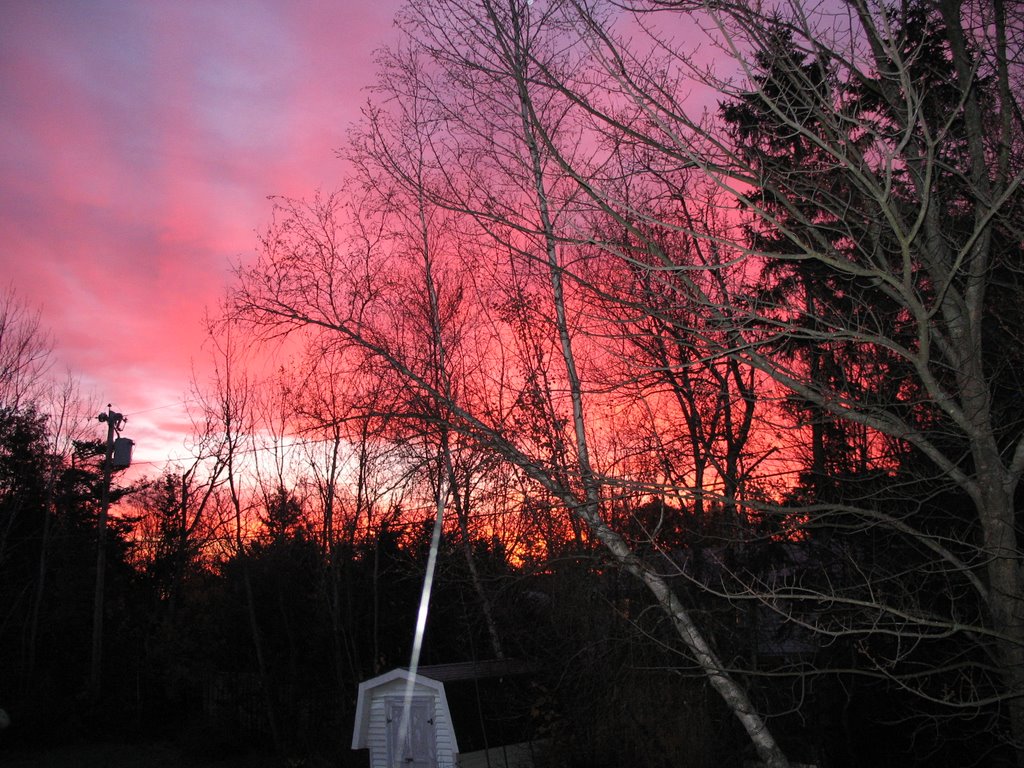
This morning from my desk, I saw a red sun, and the red quickly spread over the sky.I've never seen so much of the sky red. It had such a feeling of the apocalyptic that our guest woke up and came up here to comment on it. The white globe is the wasp nest, a picture of which I posted when it was just being constructed.
Monday, October 23, 2006

The Miracle Cactus
Twenty-four years ago, on the occasion of the launch of my first book, a friend gave me one of two cactus leaves she had brought back from California. It was a special and rare cactus, she said, and would produce beautiful flowers. I planted it; it took root and grew. For nineteen years it produced a lot of green leaves but no flowers, and then, inexplicably, buds appeared and indeed the resulting flowers were spectacular. For the first two years, it blossomed once a year, but now it blossoms three times a year. As far as I can remember, I did nothing different to induce it to bloom. We would comment on what an ugly plant it was, but because it was a special gift, we did not have the heart to throw it out. Was it our loyalty and patience that prompted it to produce? Even after five years, Bill and I are still amazed and pleased each time it blooms.
Saturday, August 19, 2006
More About Houses
We moved into our house Sept. 1 forty years ago. We had gone to stay with my parents while it was being built. When we left, it was a hole in the ground. When we arrived back, there miraculously was the house. I can’t reconstruct what image I had of it as we waited that summer in Massachusetts, but of course it was nothing like the reality. Although I got along well with my parents, who bent over backwards to make our three month stay pleasant, I was so happy to be back, to be settled, to have our own home. I was tired after the trip and after getting the beds and the crib set up. After the kids were in bed, I stepped out on the front stoop. It faces northwest and as I looked out over the trees across the street, I was startled to see northern lights, the first I had ever seen. They were, I thought, a sign that all was right with our world, that we had done the wise thing in building this house. The house was too small, mud surrounded it, and we were only the second house on the street so there were no neighbors, no streetlights. But in a few years we had finished basement, constructed a lawn, and eight years later we had an addition put on which alleviated the crush. Neighbors moved in with 53 children, and the city made a park and paved the street.
Over the years we have made many changes: the most recent ones are to have the back deck screened in and to have the washer and dryer brought up from the cellar to the back hall.
There have been moments when I have detested the place – its basement filling up with junk, its walls, ceilings and windows always covered with tobacco goo, and its leaks that let water come into the basement and through the ceiling. I am often overwhelmed with trying to keep the place clean enough to satisfy the health authorities if not my aunt, with the horror of even the most basic renovations such as painting. But it is surely true that it has been as much a part of my life as are my husband and my children, and I can hardly imagine living anywhere else.
In my parent’s homestead, my bedroom was over the kitchen and leading to it was a steep stairway with no banister, quite treacherous. The strange thing is that 60 years after I had lived there, even when my knees got creaky, I could go down those stairs without worry. It was as if my body knew those stairs in its very bones and in the synapses of its brain. I lived fulltime in that house for only eight or nine years. How deeply then must this house, that I have lived in for 40 years, be ingrained into the synapses of my brain? Often people who must be transplanted to a nursing home die within a few months. Changing abodes is perilous business.
Over the years we have made many changes: the most recent ones are to have the back deck screened in and to have the washer and dryer brought up from the cellar to the back hall.
There have been moments when I have detested the place – its basement filling up with junk, its walls, ceilings and windows always covered with tobacco goo, and its leaks that let water come into the basement and through the ceiling. I am often overwhelmed with trying to keep the place clean enough to satisfy the health authorities if not my aunt, with the horror of even the most basic renovations such as painting. But it is surely true that it has been as much a part of my life as are my husband and my children, and I can hardly imagine living anywhere else.
In my parent’s homestead, my bedroom was over the kitchen and leading to it was a steep stairway with no banister, quite treacherous. The strange thing is that 60 years after I had lived there, even when my knees got creaky, I could go down those stairs without worry. It was as if my body knew those stairs in its very bones and in the synapses of its brain. I lived fulltime in that house for only eight or nine years. How deeply then must this house, that I have lived in for 40 years, be ingrained into the synapses of my brain? Often people who must be transplanted to a nursing home die within a few months. Changing abodes is perilous business.
Friday, August 18, 2006
On Creating a Home
Over in Another Country/Walker (now called Pilgrim), Poor Mad Peter is chronicling the buying and creating of a home. I think that for most of us making a home is our single most satisfying creation.
Friends of ours bought a rather scruffy house on the banks of a lovely little river. A while ago they put on a small addition, designed by the wife, and the difference it made is amazing. Now there is a view of the river, of the bird feeders, of a magnificent tree. The house reflects their personalities too, their art collection and the art they both make.
Another couple have a house that the two created together: her weavings, antiques from both their ancestral homes, their son’s woodblock prints, a wonderful room that his carpentry created as her studio. On our street is a house that was quite plain. The new owner invented a color scheme, did landscaping, made an unusual deck. The siding he wanted was too expensive, so he literally invented another cheaper one. He changed plain Jane into something quite handsome.
Unlike most creations, a house is a collaborative affair, usually between the spouses. When the kids come along, they contribute too. Our son made a mural on the wall of his bedroom that depicts various characters in the Chronicles of Narnia.
Another friend designed a house that his son-in-law built, along with help from various members of the family. The chimney of the fireplace is so tall (twenty feet?) that his son had a hook put in the top so they all could practice rappelling.
I have already written about the camp our son created, Slow Loris.
Our local newspaper regularly has an article about someone's home, and often it is disappointing. The photos show a house straight out of a woman's decorating magazine with no stamp of the owners, no indication of the owners' personality.
Bill and I have been lazy for quite a few years about re-inventing our house.
Friends of ours bought a rather scruffy house on the banks of a lovely little river. A while ago they put on a small addition, designed by the wife, and the difference it made is amazing. Now there is a view of the river, of the bird feeders, of a magnificent tree. The house reflects their personalities too, their art collection and the art they both make.
Another couple have a house that the two created together: her weavings, antiques from both their ancestral homes, their son’s woodblock prints, a wonderful room that his carpentry created as her studio. On our street is a house that was quite plain. The new owner invented a color scheme, did landscaping, made an unusual deck. The siding he wanted was too expensive, so he literally invented another cheaper one. He changed plain Jane into something quite handsome.
Unlike most creations, a house is a collaborative affair, usually between the spouses. When the kids come along, they contribute too. Our son made a mural on the wall of his bedroom that depicts various characters in the Chronicles of Narnia.
Another friend designed a house that his son-in-law built, along with help from various members of the family. The chimney of the fireplace is so tall (twenty feet?) that his son had a hook put in the top so they all could practice rappelling.
I have already written about the camp our son created, Slow Loris.
Our local newspaper regularly has an article about someone's home, and often it is disappointing. The photos show a house straight out of a woman's decorating magazine with no stamp of the owners, no indication of the owners' personality.
Bill and I have been lazy for quite a few years about re-inventing our house.
Tuesday, August 08, 2006

A Garden Path
Bill, our son and I were up to our camp over the long weekend. I have written about the place before. It is a beautiful spot. The cabin itself is incredible, built by our son and his friend. The beams are made of the large cedar trees that had to be cut down in order for us to have a septic field. Gradually we have introduced amenities – a deck, wooden walkways to the shore of the lake, a dock, a platform down by the water, hot water, stove and fridge, ingenious double-decker beds that are a double bed on the bottom and a single bed on the top.
This weekend we were building a path designed by our son, to go around the side of the cabin and link up with the walkways. The paths are lined with cedar logs, filled with rocks. This required shoveling the rocks into a bucket and carrying it to the path. Top soil and then wood chips will be put over the rocks. I had more exercise in one day than I usually have in two weeks. I am not good at exercising for itself, but I love to exercise when it involves having something substantial at the end. I think many people my age feel this way. It is surprising to me that so many young people exercise for its own sake – walking briskly in all kinds of weather, walking on a treadmill in their cellar, or going to a gym. The franchise Curves spread like wildfire throughout North America on the principle of jumping on and off machines to lively music. If someone could invent an exercise routine where something was actually accomplished, I think it would become popular.
We haven’t been able to settle on what to call the building: cabin or cottage? For me, cabin has a romantic ring. A cabin in the woods. Thoreau’s cabin. We do have a name for the building: Slow Loris. This comes from a piece of art that Bill made and which hangs in the living room. It is of a Slow Loris (a kind of monkey creature of the sloth family), made of thick gesso, painted pink, with large red beads for eyes. Bill fell in love with the beads at a yard sale and had to figure out how to use them.
This weekend we were building a path designed by our son, to go around the side of the cabin and link up with the walkways. The paths are lined with cedar logs, filled with rocks. This required shoveling the rocks into a bucket and carrying it to the path. Top soil and then wood chips will be put over the rocks. I had more exercise in one day than I usually have in two weeks. I am not good at exercising for itself, but I love to exercise when it involves having something substantial at the end. I think many people my age feel this way. It is surprising to me that so many young people exercise for its own sake – walking briskly in all kinds of weather, walking on a treadmill in their cellar, or going to a gym. The franchise Curves spread like wildfire throughout North America on the principle of jumping on and off machines to lively music. If someone could invent an exercise routine where something was actually accomplished, I think it would become popular.
We haven’t been able to settle on what to call the building: cabin or cottage? For me, cabin has a romantic ring. A cabin in the woods. Thoreau’s cabin. We do have a name for the building: Slow Loris. This comes from a piece of art that Bill made and which hangs in the living room. It is of a Slow Loris (a kind of monkey creature of the sloth family), made of thick gesso, painted pink, with large red beads for eyes. Bill fell in love with the beads at a yard sale and had to figure out how to use them.
Thursday, July 27, 2006

Monday, July 24, 2006
Friday, July 21, 2006
Deep Thoughts
Quite a few years ago Dear Abby had a long running dialogue about which way was best to hang the toilet paper – so the paper was draping on the outside or near the wall. I don’t usually read the column, but someone mentioned this ongoing discussion as being an example of frivolity. Not long ago a friend of mine, a microbiologist, strenuously exhorted me to install the toilet paper with the hanging paper furthest from the wall so the paper wouldn’t touch where bacteria and fungus breed, the bathroom being a damp and warm place. This seemed sensible, and ever since, I have installed the roll thus.
Later I noted to my daughter that very few people will actually install the toilet paper if they happen to arrive as the old roll is used up. They will leave the new roll on the counter or the back of the toilet, presumably for someone else to install, or perhaps because it doesn’t seem worth the effort for anyone to hang it. She had also noticed this.
Putting away the dishes this morning, I got to ruminating about the process. Most people, I have noticed, put away the glasses upside down. Why, I wondered. Why put the part that is going to touch your lips onto the perhaps dusty or germy shelf? Perhaps everyone but me has completely germ-free, dust-free shelves. Perhaps they don’t want dust from the air to accumulate in the glasses.
In the kitchen I have a small terrycloth towel to wipe my hands and a separate dish towel (in New Brunswick called a tea towel) to dry the dishes. Most people, including my husband, don’t make a distinction and wipe their hands on the dish towel and if they are helping me with the dishes, grab the hand towel.
I have always envied people (usually men) who don’t have to spend any brainpower on such perhaps frivolous matters, although I did read once that D.H. Lawrence loved to wash dishes.
Later I noted to my daughter that very few people will actually install the toilet paper if they happen to arrive as the old roll is used up. They will leave the new roll on the counter or the back of the toilet, presumably for someone else to install, or perhaps because it doesn’t seem worth the effort for anyone to hang it. She had also noticed this.
Putting away the dishes this morning, I got to ruminating about the process. Most people, I have noticed, put away the glasses upside down. Why, I wondered. Why put the part that is going to touch your lips onto the perhaps dusty or germy shelf? Perhaps everyone but me has completely germ-free, dust-free shelves. Perhaps they don’t want dust from the air to accumulate in the glasses.
In the kitchen I have a small terrycloth towel to wipe my hands and a separate dish towel (in New Brunswick called a tea towel) to dry the dishes. Most people, including my husband, don’t make a distinction and wipe their hands on the dish towel and if they are helping me with the dishes, grab the hand towel.
I have always envied people (usually men) who don’t have to spend any brainpower on such perhaps frivolous matters, although I did read once that D.H. Lawrence loved to wash dishes.
Tuesday, July 18, 2006
Resurrecting the Old Community
My neighbor and good friend Jack is trying to resurrect our old street community. He collects for two, even some years three, good causes, and introduces himself to the new people. He has made a chart with the name of each family. Last year he had a party for the whole street. Most of the neighbors were enthusiastic about the project, brought tons of food and drink, helped out with the setting up and the taking down of the tables, and washed the dishes. I met three families I hadn’t known before.
In May a new family moved in beside us, and they are very friendly and obviously lonesome. Twice the wife has brought us some of their native food. They have two lively children. How lovely to have children around. As one of our neighbors said, Having only old people around is gloomy. It reminded her of death and sickness.
My parents didn’t visit the neighbors – the neighbors visited them. It was always the gathering spot for the adults, and then for my friends and the friends of my brother. I just realized, I am like my parents. People come here. I don’t visit them. Last night, sitting on our porch, the new neighbor said, poignantly, “Why don’t you visit me?” I realized I had to make the effort, but I don’t really know how “to drop in.” I can hardly think of how it can be done. Changing the lifetime habit of mind is going to be difficult. The lady across the street comes to our house two or three times a day, has a cigarette and a cup of coffee. She has done this for the 6 or so years she has lived here, but I have been in her house perhaps only 10 times.
Our little corner of the street, five houses, is now quite a friendly spot. Because I grew up in a little village where everyone knew each other, I do long for a close-knit neighborhood, so I am grateful.
In May a new family moved in beside us, and they are very friendly and obviously lonesome. Twice the wife has brought us some of their native food. They have two lively children. How lovely to have children around. As one of our neighbors said, Having only old people around is gloomy. It reminded her of death and sickness.
My parents didn’t visit the neighbors – the neighbors visited them. It was always the gathering spot for the adults, and then for my friends and the friends of my brother. I just realized, I am like my parents. People come here. I don’t visit them. Last night, sitting on our porch, the new neighbor said, poignantly, “Why don’t you visit me?” I realized I had to make the effort, but I don’t really know how “to drop in.” I can hardly think of how it can be done. Changing the lifetime habit of mind is going to be difficult. The lady across the street comes to our house two or three times a day, has a cigarette and a cup of coffee. She has done this for the 6 or so years she has lived here, but I have been in her house perhaps only 10 times.
Our little corner of the street, five houses, is now quite a friendly spot. Because I grew up in a little village where everyone knew each other, I do long for a close-knit neighborhood, so I am grateful.
Sunday, July 16, 2006
Community
Religion is more like a response to a friend than it is like obedience to an expert. Austin Farrer
We lucked into a wonderful community. We bought a small (1000 square feet) house in a new subdivision. Ours was the second house built on our street. We chose the plan from a book of small house plans put out by the Canadian government, and since we didn’t have any money, having just come from graduate school in the USA, we chose the smallest. That the government would put out such a book seemed unusually thoughtful. The builders, two brothers, were the kind of men that makes New Brunswick so special – humble, honest, conscientious gentlemen, using the word gentlemen with all its best connotations.
Soon there were people who turned the street into a real community, with carol sings, coffee parties, baby showers, birthday parties. The house of our next-door neighbor became the hub for the adults, with people stopping in for tea frequently. The wife kept us all informed of the goings on, a gossip in a good, not a mean way. A few months after Christmas one year, our youngest son said, “There isn’t any Santa Claus, is there?” “Who do you think brings the presents then?” “Dot?” Dot was this next door neighbor.
Ours is the most humble house on the street, but none of them is grand. The house has served us well, although eight years later we put on an addition. We again got lucky. The woman who designed the addition did a super job, convincing us that it wouldn’t be much more expensive to have a two story addition – a bedroom half in the ground with a room up above. This extra room that we didn’t expect is a lovely room, with large windows on all four sides and a lovely view of our backyard, right now lush with its grove of deciduous trees.
My daughter once told me that playing with Barbie dolls on the deck of one of our neighbors, she thought to herself, I’ll never be as happy again as I am right now. The two builders had designed the subdivision with a park in the middle, and it became the hub of the community for the children. The kids played baseball there, and in the winter the city made a skating rink.
Over the 40 years we have lived on this street, I have often thought of the concept of community, of what makes a good one. In the beginning, there was nothing but mud, and we all had to make lawns, a miracle really, and the kids played on the muddy street, road hockey (new to us), constructing dams and rivers. The builders had also designed the street with two curves, to make it difficult for cars to speed. Most of the residents were New Brunswickers, although there were 8 families “from away.” There were 5 professors, a lawyer, a doctor, two teachers, some businessmen, but most of the men worked for the NB government. Only one of the women worked outside the home, although the rest were plenty busy with volunteering, art, serious hobbies, church.
Of course there were sadnesses. There seemed to be an unusual number of deaths from cancer. Kids got into trouble, but an astonishingly high percentage of them turned out fine. People have moved or died over the years, and the 53 children have all grown up and gone. Of the original 25 families, only 10 remain. That is sad too.
We lucked into a wonderful community. We bought a small (1000 square feet) house in a new subdivision. Ours was the second house built on our street. We chose the plan from a book of small house plans put out by the Canadian government, and since we didn’t have any money, having just come from graduate school in the USA, we chose the smallest. That the government would put out such a book seemed unusually thoughtful. The builders, two brothers, were the kind of men that makes New Brunswick so special – humble, honest, conscientious gentlemen, using the word gentlemen with all its best connotations.
Soon there were people who turned the street into a real community, with carol sings, coffee parties, baby showers, birthday parties. The house of our next-door neighbor became the hub for the adults, with people stopping in for tea frequently. The wife kept us all informed of the goings on, a gossip in a good, not a mean way. A few months after Christmas one year, our youngest son said, “There isn’t any Santa Claus, is there?” “Who do you think brings the presents then?” “Dot?” Dot was this next door neighbor.
Ours is the most humble house on the street, but none of them is grand. The house has served us well, although eight years later we put on an addition. We again got lucky. The woman who designed the addition did a super job, convincing us that it wouldn’t be much more expensive to have a two story addition – a bedroom half in the ground with a room up above. This extra room that we didn’t expect is a lovely room, with large windows on all four sides and a lovely view of our backyard, right now lush with its grove of deciduous trees.
My daughter once told me that playing with Barbie dolls on the deck of one of our neighbors, she thought to herself, I’ll never be as happy again as I am right now. The two builders had designed the subdivision with a park in the middle, and it became the hub of the community for the children. The kids played baseball there, and in the winter the city made a skating rink.
Over the 40 years we have lived on this street, I have often thought of the concept of community, of what makes a good one. In the beginning, there was nothing but mud, and we all had to make lawns, a miracle really, and the kids played on the muddy street, road hockey (new to us), constructing dams and rivers. The builders had also designed the street with two curves, to make it difficult for cars to speed. Most of the residents were New Brunswickers, although there were 8 families “from away.” There were 5 professors, a lawyer, a doctor, two teachers, some businessmen, but most of the men worked for the NB government. Only one of the women worked outside the home, although the rest were plenty busy with volunteering, art, serious hobbies, church.
Of course there were sadnesses. There seemed to be an unusual number of deaths from cancer. Kids got into trouble, but an astonishingly high percentage of them turned out fine. People have moved or died over the years, and the 53 children have all grown up and gone. Of the original 25 families, only 10 remain. That is sad too.
Friday, May 26, 2006
Coming Home
In our graduate student housing was a young Central American woman, who through an improbable set of circumstances, had married a wealthy and sophisticated European. As she explained to me, she herself had come from a poor background. When her son developed an ear ache, I drove her to our pediatrician, a professor in the Medical School. He prescribed an antibiotic. The next day I noticed that the little boy had a clove of garlic on a string around his neck. His mother said, sheepishly, that she didn’t want to take any chances. I knew how she felt because I myself did then -- and still do -- practice what most people would regard as superstitions when it comes to the welfare of my children.
Not long ago I read that you never really feel at home in a foreign land until you trust the doctors. One January night four months after we arrived in New Brunswick, I felt contractions with my third child. It was snowing, and so even though we were less than a mile from the hospital, to be on the safe side Bill drove me to the hospital. After the obstetrician had examined me, the nurse told me not to worry about the storm because the doctor was going to sleep at the hospital. I had been in this foreign country for only four months, but at that moment I felt I had come home.
Not long ago I read that you never really feel at home in a foreign land until you trust the doctors. One January night four months after we arrived in New Brunswick, I felt contractions with my third child. It was snowing, and so even though we were less than a mile from the hospital, to be on the safe side Bill drove me to the hospital. After the obstetrician had examined me, the nurse told me not to worry about the storm because the doctor was going to sleep at the hospital. I had been in this foreign country for only four months, but at that moment I felt I had come home.
Sunday, April 30, 2006
A Church House
A house we lived in for a few months had been first a barn, then a church, and finally a duplex. One of my favorite books is Elizabeth Goudge’s Pilgrim’s Inn, the second in a trilogy about the Eliots. The story is of a family purchasing a house and discovering slowly that it had once been an inn for pilgrims and that a pantry had once been a chapel. The house, it is suggested, had such a holy atmosphere that the people who lived in it were protected and the marriage saved. The first novel of that trilogy was about a grandmother purchasing a house to make into a sanctuary for her children and grandchildren during World War Two.
When our daughter went away to university, we spruced up the bathroom, nothing extreme, just a new tub surround, wallpaper, and flooring. I thought how pleased she was going to be, but instead, she burst into tears, “I knew you would change everything while I was gone.” I felt that way myself when my parents’ house was purchased and renovated. The renovations were necessary and tastefully done, but the memory I had in my mind of a cozy, rosy interior was discombobulated.
I remember very little of living in the former church. My father repeated anecdotes of our living there, of the funny things my two year old brother did there, but I remember these repeated anecdotes, not the house itself. Our village had many lovely colonial and Victorian houses, but in fact the church/duplex was then and still is one of the two ugliest, poorest houses there. Five or six years after we left, a large family moved into one of the duplexes, and some of them are still living there. Although they were poor and rough around the edges, they appeared to be a happy family and much admired.
When our daughter went away to university, we spruced up the bathroom, nothing extreme, just a new tub surround, wallpaper, and flooring. I thought how pleased she was going to be, but instead, she burst into tears, “I knew you would change everything while I was gone.” I felt that way myself when my parents’ house was purchased and renovated. The renovations were necessary and tastefully done, but the memory I had in my mind of a cozy, rosy interior was discombobulated.
I remember very little of living in the former church. My father repeated anecdotes of our living there, of the funny things my two year old brother did there, but I remember these repeated anecdotes, not the house itself. Our village had many lovely colonial and Victorian houses, but in fact the church/duplex was then and still is one of the two ugliest, poorest houses there. Five or six years after we left, a large family moved into one of the duplexes, and some of them are still living there. Although they were poor and rough around the edges, they appeared to be a happy family and much admired.
Subscribe to:
Posts (Atom)